

Ask people what genre they think film music is—is it classical? You will get widely varying responses. For some people, film music is a subgenre of classical music; for others, it is a completely separate genre that stands on its own. This June, the Daily Classical Music Post will look at the origins of film music and discover how it has evolved.
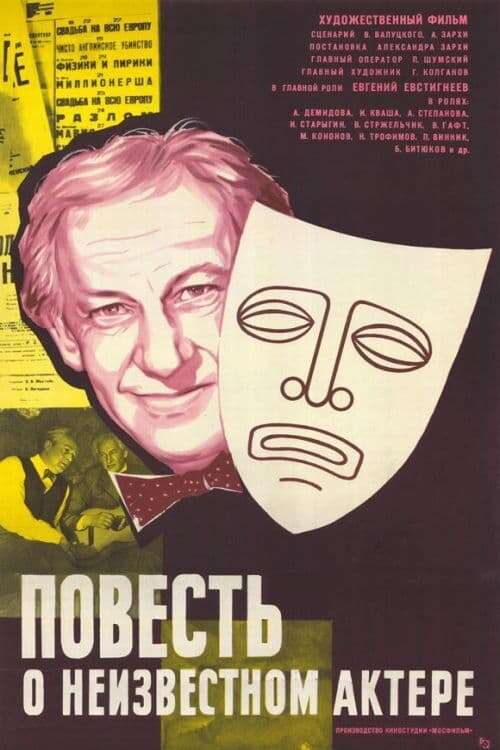
The Story of an Unknown Actor: I
In the Stalinist era, which began in the late 1920s, Soviet Russia experienced intense political and social transformation. The arts were strictly controlled; the idea was that all art should be accessible to the masses and must depict workers as heroes whose main goal in life was to glorify the achievements of the Soviet Union. Soviet cinema and music had to conform to the official style. The films that were released during this era were very different from those released in the United States of America in the 1960s and 1970s. Ciara Moloney wrote, “The U.S. sought to prove that it was possible to make great art under free market capitalism. The U.S.S.R. sought to prove that it was possible to make great art under centrally planned communism.”
Dan Golding wrote, “During the Stalinist era in particular, the films were ideological and frequently propagandist, and many have rarely been seen outside Soviet cinema halls, even after the fall of the Iron Curtain. Yet unlike other great national cinema industries, there was also never a significant distinction between a concert hall composer and a film composer—meaning that greats like Shostakovich, Prokofiev, and Khachaturian wrote many popular film scores in their time. Many of these composers’ most popular works—such as Prokofiev’s Alexander Nevsky or Shostakovich’s Romance—found their origins not in the concert hall, but at the movies.”
One of the most prolific Soviet film composers was Alfred Schnittke (1934–1998). Schnittke studied composition at the Moscow Conservatory and although he composed many works for the concert stage and taught composition at the Conservatory, he mainly earned a living by composing film scores: approximately 70 in 30 years. He—like the main influence on his early music, Dmitri Shostakovich—often ran into difficulties with the Soviet government and the Composers Union, and he was banned from travelling outside the USSR in 1980. It was only through the efforts of several émigré artists that his music, which by that time was in a new style that he had begun developing in the mid-1960s that he called polystylism, became more widely known.
In 1977, the Soviet director Aleksandr Zarkhi asked Schnittke to compose the score for his film Story of an Unknown Actor. The score to this film is in his polystylist style but is more neo-romantic than pretty much any of his other work for film or concert hall. Rob Barnett wrote, “[The film] opens with a noble surging and pushing theme for harpsichord and strings. There is a suggestion of the grand baroque concerto about this music but it has much more emotion and visceral excitement. This is extremely striking music headlong and desperate with a vein of sadness.” This theme re-occurs throughout the score, sometimes as a fugue, sometimes as a gentle and humble melody. The score incorporates elements of Romantic, Baroque, and even popular music (at least, what popular music was allowed by the Soviet authorities in the 1970s). Schnittke uses the different styles to support the emotional arc of the film, which is about an actor in a provincial theatre who loses out on a role to a younger actor. Partly because Schnittke’s score for Story of an Unknown Actor was so different from his other work, it is considered to be one of his best.
Before leaving today’s post, I just want to mention the extraordinary score that Schnittke composed for the short animated film The Ballerina on the Boat (1969). You can watch it here: Ballerina on the Boat Lev Atamanov Alfred Schnittke. The 16-minute film won the Silver Pelican award at the 1970 III FFF. The animation is absolutely beautiful, but what really stands out for me is Schnittke’s incredible score. All of the action is described beautifully in the music, and the sounds of the ship and movements of the characters are created perfectly by the orchestra. One reviewer noted that the film “has a strong 1950s feel, enhanced by the peppered modern music by star composer Alfred Schnittke.”
My classical music post for today is Alfred Schnittke’s Story of an Unknown Actor: Main Theme.


Leave a Reply