

Ask people what genre they think film music is—is it classical? You will get widely varying responses. For some people, film music is a subgenre of classical music; for others, it is a completely separate genre that stands on its own. This June, the Daily Classical Music Post will look at the origins of film music and discover how it has evolved.
OST Jaws (1975): 01. Main Title
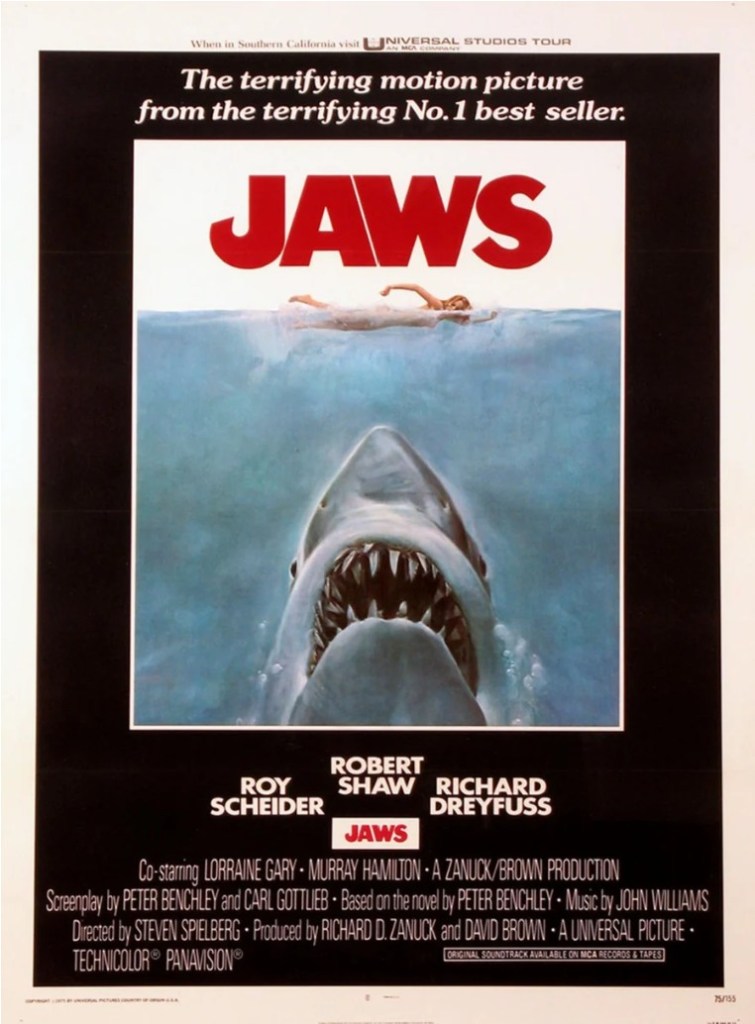
In 1975, Steven Spielberg released Jaws, with a score by the American composer John Williams (born 1932). Spielberg and Williams had already collaborated on The Sugarland Express the year before, and Spielberg knew that he wanted Williams to compose the score for his new thriller. Before Williams began work on the score, however, Spielberg “temped” (i.e., used pre-existing music temporarily) the first cut with music Williams had composed for a horror movie in 1972. Williams immediately collapsed with laughter, saying, “No, no, no. It’s all wrong for this. You’ve made a pirate movie with a scary shark. It’s got to be primal. It can’t be esoteric.”
And then Williams played the opening of what became the Jaws Main Theme, also known as the Shark Theme, on the piano for Spielberg, who reportedly thought it was a joke at first. He then listened again, and later recalled, “Sometimes the best ideas are the simple ones, and John had found the signature for the whole movie. Without that score, to this day, I believe the film would have been only half as successful.”
Williams intended those first two notes, which even today strike fear into the heart of listeners, to be as he said in an interview “simple, insistent and driving, that it seems unstoppable, like the attack of the shark.” Filippo Faustini wrote, “He makes use of the most simple compositional means to build an astonishingly remarkable score. The main building block of this construction is the interval of a minor second, the most unsettling interval there is. This interval is so dissonant because of the harmonics inherent in these notes (E and F for example). This interval is played firstly as a distant sound and then it is repeated faster and faster in order to mimic the arrival of a shark, or perhaps the speeding up of one’s heartbeat from such an anxious encounter. The horn notes on top of this string ostinato are also derived from a minor second (a little bit like the music in the shower scene in Psycho).”
Maurizio Caschetto wrote, “Williams’s brilliant scoring modus operandi is perfectly exemplified in the opening scene, where the music enters quietly and almost creepily, with chromatic piano and harp arpeggios punctuated by the low end of celli and basses. The music slowly builds in tension and also in size, and finally launches a violent, Stravinsky-ian orchestral attack. . . . The orchestration of the theme is peculiar because, besides the low basses, celli and trombones playing the ostinato, it also features a highly chromatic tuba solo, which is quite hard to play. The solo is heard not just in the main title, but occurs many times throughout the picture.” Williams’s score is a masterclass in film scoring; the music not only represents the character of the shark but it becomes the character of the shark. Williams cleverly uses those two notes throughout the film to let the audience know that something is about to happen and they’d best prepare themselves. And no one can hear that opening today without feeling a touch of fear.
My classical music post for today is John Williams’s Jaws: Main Title.


Leave a Reply