

Ask people what genre they think film music is—is it classical? You will get widely varying responses. For some people, film music is a subgenre of classical music; for others, it is a completely separate genre that stands on its own. This June, the Daily Classical Music Post will look at the origins of film music and discover how it has evolved.
Main Title (from “Planet Of The Apes”) (Official Audio)
Science fiction film scores are perfect for new and unusual instrumentation. The first film scores to incorporate electronic instruments were those for science fiction movies, as we saw earlier this month with Bernard Herrmann’s score for The Day the Earth Stood Still. In 1956, electronic music pioneers Bebe and Louis Barron invented their own instruments, using magnetic tape to create their score for Forbidden Planet. Their soundtrack was so unusual that the American Federation of Musicians wouldn’t classify it as music; instead, the Barrons were listed in the credits as “creators of electronic tonalities.” Although their work was dismissed in this way, they still had a big influence on the whole genre of science fiction film music.
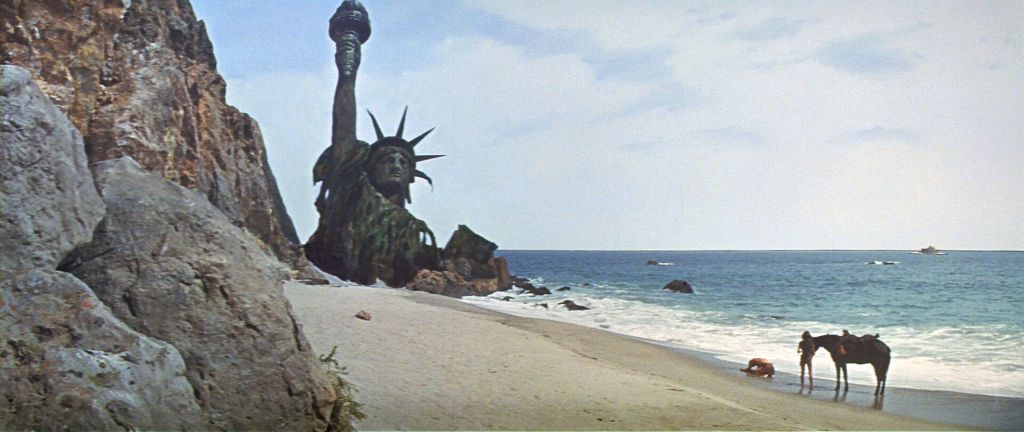
The American composer Jerry Goldsmith (1929–2004), who composed scores for numerous science fiction movies, was incredibly innovative. He studied theory and composition with the progressive neoclassical composer Mario Castelnuovo-Tedesco, and Goldsmith’s music shows influences of his teacher as well as modernism, impressionism, and electronic music. Goldsmith said that he also was influenced by composers including Igor Stravinsky, Aaron Copland, Béla Bartók, and Alban Berg. Goldsmith’s early scores were for television series produced by CBS, where he worked initially as a clerk typist. In 1962, he composed a mostly atonal score for a biopic of Sigmund Freud, which led to his first Academy Award nomination for Best Music Score (he had 18 nominations in his career, winning once, in 1976, for The Omen). He went on to compose scores for a wide variety of films, but it was his avant-garde score for Planet of the Apes (1968) that solidified his reputation as an innovative, experimental, and exciting film composer.
A review in Gramophone called the score for Planet of the Apes “a milestone” and said, “Goldsmith uses a traditional orchestra, albeit heavily augmented by exotic percussion (including, notoriously, stainless-steel mixing bowls) to fashion a work that is both primitive and futuristic; an exhilarating combination of Bartok and Stravinsky-influenced textures and grittily relentless action writing typical of the composer from this period.”
Keith Bayley wrote, “It could be argued that Jerry Goldsmith’s revolutionary score turned a decent sci-fi movie into something legendary and iconic. . . . He used radical instrumentation, avant-garde composing and bizarre instructions for the orchestral players—e.g harmonics in the strings, various bowing techniques and French horn players reversing their mouthpieces and blowing air through the horns. Other instrumental highlights included Brazilian percussion, mixing bowls (from the composer’s own kitchen) and most memorably, the ram horn that appears one minute into ‘The Hunt’ cue. The overall effect is destabilising, cacophonous, urgent; creating a dystopian world out of familiar elements. Which of course is very fitting, given the film’s famous final scene.”
My classical music post for today is Jerry Goldsmith’s Planet of the Apes: Main Title.


Leave a Reply