

The first day of May is International Workers’ Day. Workers and the labour movements are celebrated worldwide on this day. This May, the Daily Classical Music Post will honour and commemorate the struggles, achievements, rights, and gains of workers through music.
Songs of Sundrie Natures: No. 41, Who Made Thee, Hob, Forsake the Plough?
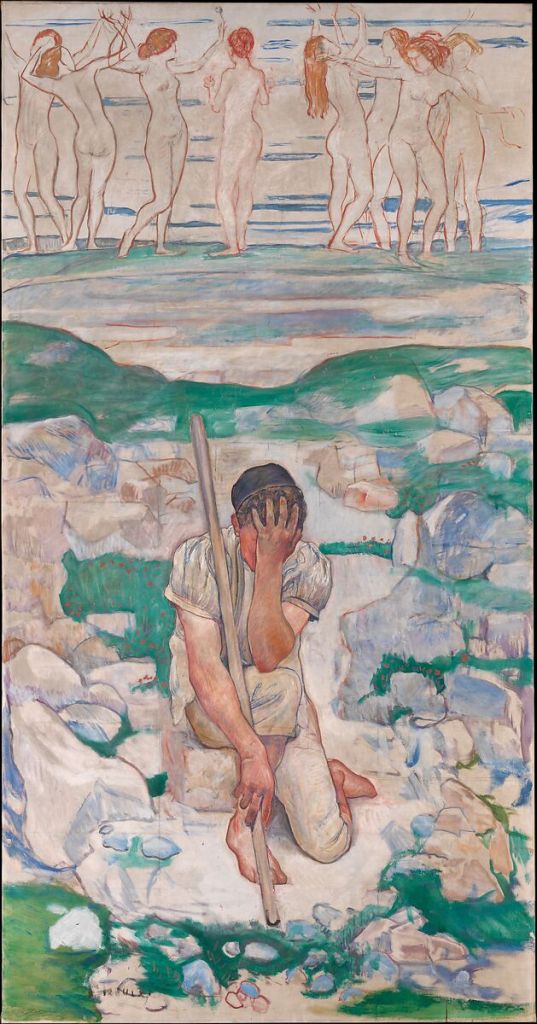
The image of the shepherd as a dreamer, sitting on a hill under a tree while his sheep graze in the distance, has been a popular and common one throughout history. Many artists have explored this in their works; for example, the Swiss artist Ferdinand Hodler’s Der Traum des Hirten (today’s image) imagined a shepherd dreaming of women. And composers have also used the theme of the dreaming shepherd in their music.
“Who Made Thee, Hob, Forsake the Plough?,” a madrigal by the English Renaissance composer William Byrd (c. 1540–1623), is a dialogue between “Hob” (a shepherd) and an unnamed other person. Hob has been dreaming of a woman and has abandoned his farming and shepherding to pursue her. The other person tells Hob to be careful as the woman is too important for the likes of him, but Hob says, “Yet love I must or else I die.” “Who Made Thee, Hob, Forsake the Plough?” was composed in 1589 for two altos with viol consort and was published in his Songs of Sundrie Natures.
Most of Byrd’s music is, as Rory McCleery wrote, “gloomy allegories for the state of the English Catholic community or pleas for divine intervention closely linked to the execution of English Catholic martyrs, many of whom were known personally to Byrd . . . But a glimmer of levity can be found in Byrd’s secular vocal works: although again there is a preponderance of laments and elegies, and Byrd eschews entirely the ‘fa-la-la’s of the madrigal so heartily embraced by his peers and successors, the odd moment of dry humour can be found in his songs, as in Who made thee Hob, a duet in which Byrd satirises the overwrought emotion of the choirboy plays of the English theatre.”
My classical music post for today is William Byrd’s “Who Made Thee, Hob, Forsake the Plough?”


Leave a Reply