

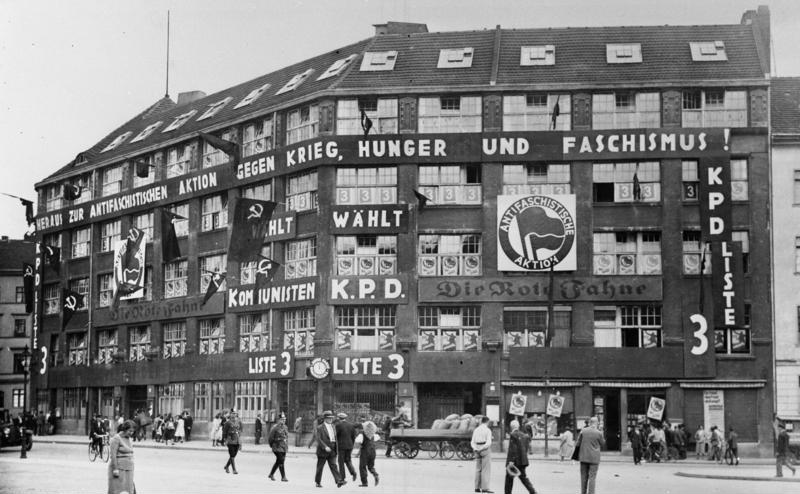
The first day of May is International Workers’ Day. Workers and the labour movements are celebrated worldwide on this day. This May, the Daily Classical Music Post will honour and commemorate the struggles, achievements, rights, and gains of workers through music.
Hanns Eisler – Einheitsfrontlied, Solidaritätslied, Linker Marsch
The German-Austrian composer Hanns Eisler (1898–1962) had a long association with the German poet and playwright Bertolt Brecht. They met working in theatre in Berlin around the time that they both became interested in Marxism. Eisler, who had been one of Arnold Schoenberg’s favourite students, upset his teacher by incorporating jazz and cabaret styles in his music, and they also fell out over Eisler’s political views. Eisler began to collaborate with Brecht, writing works that celebrated the working class. Many of the songs that the two wrote together focused on the struggles of the working poor and unemployed.
Brecht wrote the revolutionary poem “Solidaritätslied” (Solidarity Song) between 1929 and 1931, and Eisler set it to music in 1931. It quickly became popular at street protests and sporting events. Brecht updated the text during the Spanish Civil War. Martin Conrads wrote, “The ‘singing of songs associated with the German labour movement’ has been an official part of Germany’s Intangible Cultural Heritage since 2014. This also includes the singing of the Solidaritätslied from the 1932 film Kuhle Wampe or: Who Owns the World? . . . Kuhle Wampe, a combination of feature film and documentary, directed by Bulgarian filmmaker Slatan Dudow and co-written by playwright Bertolt Brecht, is widely regarded as one of the Weimar Republic’s most powerful rallying cries for the working class to unite and champion the causes of socialism.”
Kuhle Wampe means ‘empty stomach’ in the Berlin vernacular. “Solidaritätslied” was sung at the end of the film, and the final two verses resonated with audiences: “Workers of the world, uniting / That’s the way to lose your chains. / Mighty regiments now are fighting / That no tyranny remains! // Forward, without forgetting / Till the concrete question is hurled / When starving or when eating: / Whose tomorrow is tomorrow? / And whose world is the world?”
“Solidaritätslied” is written in a simple verse and chorus form, with the verses sung by a soloist. Joy Calico wrote of “Solidaritätslied” and Eisler’s other songs for the workers’ movement, “They are eminently singable and impossible to forget; it is not hard to understand how millions worldwide marched toward revolution with these songs on their lips. They are also superbly crafted. In addition to his hallmark driving bass lines and catchy tunes in the minor mode, one finds sophisticated harmonic nuance and rhythmic/metric variety that far exceed the minimum requirements for a protest or mass song.”
My classical music post for today is Hanns Eisler’s “Solidaritätslied.”


Leave a Reply