

The first day of May is International Workers’ Day. Workers and the labour movements are celebrated worldwide on this day. This May, the Daily Classical Music Post will honour and commemorate the struggles, achievements, rights, and gains of workers through music.
Dmitri Shostakovich – Symphony No. 3 in E-Flat Major, Op. 20 “The First of May”
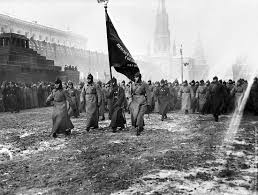
The first day of May was an especially significant day in the Soviet Union. The government established it as a day to support the working class. Massive parades were held in Red Square to celebrate the strength and power of the Soviet Union. It was a powerful tool in the Soviet propaganda war, particularly during the reign of Josef Stalin.
The Soviet composer Dmitri Shostakovich (1906–1975) was a graduate student at Leningrad Conservatory when he composed both his second and third symphonies. The single-movement Symphony No. 3, first performed in 1930, was titled “The First of May.” Shostakovich wrote, “While in the [Second Symphony] the main content is struggle, the ‘May First’ expresses the festive spirit of peaceful construction, if I may put it that way. To make the main idea clearer for the listeners, I introduced a chorus to words by the poet Kirsanov at the end.” Symphony No. 3 was the first of Shostakovich’s works to reflect the new rules set out by the Russian Association of Proletarian Musicians, which specified that music should be clear and simple with strong rhythms and some kind of political message. Shostakovich said of the work, “It would be interesting to write a symphony where not a single theme would be repeated”; the idea was to make it like a parade, with snippets of music passing by the listeners as the marchers moved on.
The finale with a text by the Soviet poet Semyon Isaakovich Kirsanov praises May Day as well as the October Revolution. The last three stanzas make clear the intention: “We will reap the land. / Our time has come. / Workers, listen to the voices of our factories. / To burn the old, you need to ignite a new reality. / A flag rising like the sun, / March, let your steps ring. / Every May Day is a step towards socialism. / May Day is a march of armed miners. / To the square, revolution, / March at a million feet!”
Howard Posner wrote, “Shostakovich wrote his “First of May” on his own initiative, without a commission or particular performance in mind. May 1st was always a major day of celebration in the Soviet Union, not because it was an anniversary of any event . . . but because it had been designated a labor holiday by the Second Socialist International in 1889.” Harlow Robinson wrote, “Looking back, Shostakovich himself admitted there were ‘a number of shortcomings’ in the Third Symphony, but that it was an honest ‘attempt to reflect life’ and a ‘useful’ step in his creative development.”
My classical music post for today is Dmitri Shostakovich’s Symphony No. 3, “The First of May.”


Leave a Reply