

The first day of May is International Workers’ Day. Workers and the labour movements are celebrated worldwide on this day. This May, the Daily Classical Music Post will honour and commemorate the struggles, achievements, rights, and gains of workers through music.
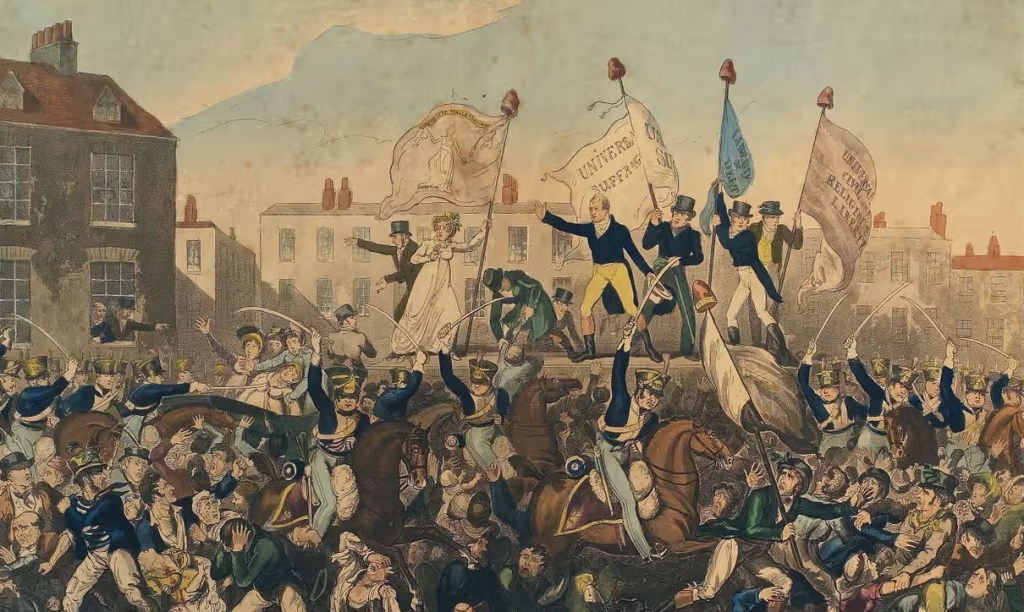
On 16 August 1819, a group of approximately 80,000 people gathered in St Peter’s Field, Manchester, England, to protest chronic unemployment and call for parliamentary reform and voting rights for the working classes. Local magistrates called in the army; although there are no definitive numbers, it is believed that up to 18 people died and between 400 and 700 people were injured as a result. The immediate upshot was a crackdown on protests and a ban on trades unions of any kind. However, by 1824, unions began popping up again around Great Britain, and by the 1860s, with the establishment of the Trades Union Congress (TUC), workers had organized and were ready once again to fight for better conditions.
In 1968, the English composer Malcolm Arnold (1921–2006) was commissioned by the TUC to write a work to commemorate the centenary of the first meeting of that organization. Peterloo was originally composed for orchestra, and other composers later arranged it for wind band, brass band; there also is a choral version with text by Tim Rice. Bob Briggs wrote, “Malcolm Arnold does himself, and his work, no favours by calling Peterloo an Overture, when it is, quite obviously, a major tone poem. . . . In three sections, the work starts with a rich, but simple, tune which is quickly interrupted by three side drums and then mayhem ensues. The piece ends with a repeat of the opening theme, now a lament, but filled with hope and expectation of better things.”
In 1919, James Haslam recalled talking with someone who had been at Peterloo, and he recounted what that person told him in an article written for The Guardian: “Peterloo, lad! I know. I were theer as a young mon. We were howdin’ a meetin’ i’ Manchester—on Peter’s Field,—a meetin’ for our reets—for reets o’mon, for liberty to vote, an’ speak, and write, an’ be eawrsels—honest, hard-workin’ folk.” An editorial published in the same newspaper said, “Peterloo taught the workers that the real enemy of freedom was not fastened up in St. Helena, but was entrenched in their own country. Contrasting the power of the strike with the power of the vote, he asserted that if the workers refused to develop the power of the vote they could not expect to win the better conditions for which the Peterloo martyrs had met.”
The composer wrote in his programme notes, “Peterloo is the derisive name given to an incident that happened on August 16th, 1819 in St Peter’s Fields Manchester, when an orderly crowd of some 80,000 people met to hear a speech on political reform. On the orders of the magistrates they were interrupted by the yeomanry attempting to seize the banners they carried, and to arrest their speaker, Henry Hunt. Cavalry were sent in, and eleven people were killed and four hundred injured in the ensuing panic. This overture attempts to portray these happenings musically, but after a lament for the killed and injured, it ends in triumph, in the firm belief that all those who have suffered and died in the cause of unity amongst mankind, will not have died so in vain.”
My classical music post for today is Malcolm Arnold’s Peterloo.


Leave a Reply