

The first day of May is International Workers’ Day. Workers and the labour movements are celebrated worldwide on this day. This May, the Daily Classical Music Post will honour and commemorate the struggles, achievements, rights, and gains of workers through music.
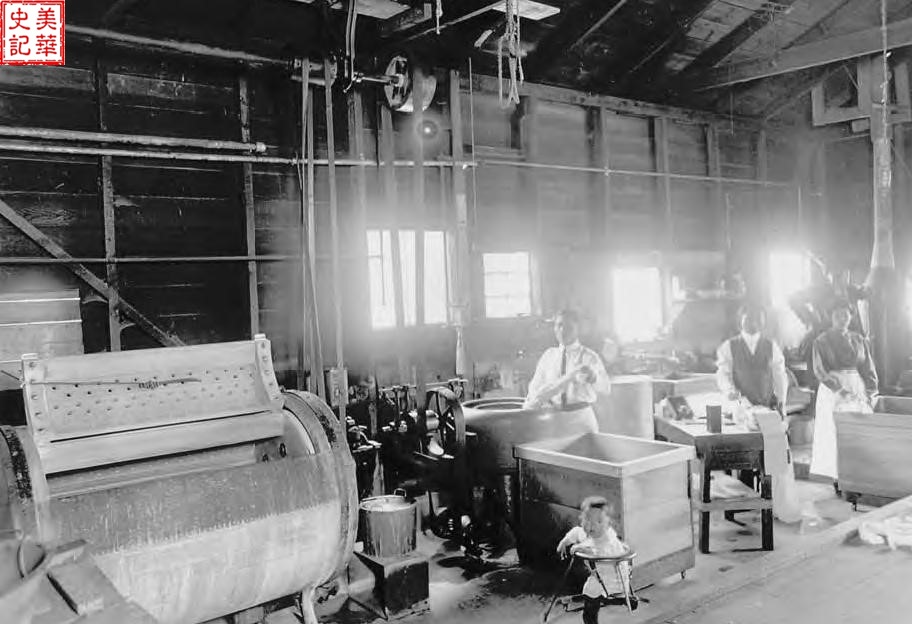
It didn’t take long after people from China began arriving in the United States in the 19th century for discriminatory practices and laws to be enacted. Xi Luo wrote, “It would not be easy for the Chinese to survive in a country whose political and social institutions fought against them. Furthermore, the laundry industry was unattractive to whites. . . . However, for the Chinese immigrants who didn’t know English, this profession was suitable, requiring only a small investment of about $500 for start-up capital. Thus, the laundry industry allowed these immigrants to secure their own livelihoods. . . . Therefore, although laundry is a dull, toiling job, for many early Chinese immigrants it was the only way to survive in a land where social, economic and political conditions worked against them.”
The “ultramodernist” American composer Ruth Crawford Seeger (1901–1953) was always dedicated to supporting workers and immigrants, and in her music she aimed to express revolutionary content through modernist experimental compositional techniques. She once said, “It became almost immoral to closet oneself in one’s comfortable room and compose music for its own delight.” Most of her works date from the 1920s and 1930s; she spent the rest of her life studying and cataloguing folk music. She wrote, “People can be made aware that many of the songs about their everyday lives . . . are songs of merit. This gives them a new sense of dignity and pride in their cultural heritage. . . . The folk song grows out of reality. It is this stark reality and genuineness, which gives the folk song vitality and strength.”
In 1932, Crawford composed settings of two poems about the plight of immigrant labourers in the United States written in 1928 by the young Chinese writer H.T. Tsiang. The second of these, “Chinaman, Laundryman,” is about a boss who verbally assaults his employee and the launderer who describes the harsh working conditions. The song, for mezzo-soprano and piano, employs Sprechstimme, which gives primacy to the text. It begins with the worker singing in the voice of the boss, who calls out to the launderer using the derogatory term “Chinaman” to provoke the launderer, and ends with the launderer exhorting all Chinese laundry workers to unite and fight against discrimination and exploitation. Judith Tick wrote, “[T]he ‘remorseless’ patter of the piano part in ‘Chinaman, Laundryman’ transmits the pervasive oppression of the capitalist boss on an exploited worker and the inhumanity of his underpaid manual labor.”
Ellie M. Hisama wrote, “Although ‘Chinaman, Laundryman’ is not an example of the mass-song style that the Composers’ Collective was instrumental in developing during the 1930s, Crawford’s song recalls a few of its characteristic features: the text is given primacy in order to emphasize its message, and its setting is syllabic. . . . But with its serial piano accompaniment given in octaves throughout, ‘Chinaman, Laundryman’ does not share other traits of mass-song style, including a homophonic texture and a bass containing many octaves and fifths, elements that would have made the songs more suitable for performance by a workers’ chorus. . . . ‘Chinaman, Laundryman’ is politically significant not only for its choice of text, which portrays the oppressive working conditions of the immigrant ethnic laborer, but also for its musical setting.”
My classical music post for today is Ruth Crawford Seeger’s “Chinaman, Laundryman.”


Leave a Reply