

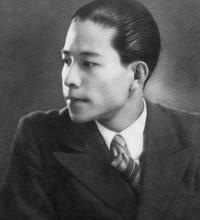
There has always been a cultural exchange between the arbitrarily divided regions labelled East and West. However, the overwhelming influence of European and U.S. art and folk music often obliterated the traditional classical music in Asia. This March, the Daily Classical Music Post explores music by Asian composers who have sought to redress the balance.
[Chiang Wen-yeh] Woodwind Trio Op.63 (Score-Video)
The Taiwanese composer Chiang Wen-yeh (1910–1983) was more usually known in Europe and the United States of America as Bunya Koh. He was born in what was at the time Japanese territory, so although his parents were Chinese, his nationality was Japanese. He spent his childhood and youth in Japan, studying engineering and then music in Tokyo as a young adult. He was well known as an opera singer before concentrating on composition.
Chiang was the first Taiwanese composer to win a medal at the Olympic Games, for his orchestra work “Formosa” (1936), which he dedicated to Taiwan. Until 1945, when Chiang lost his Japanese nationality following the Japanese surrender at the end of World War II, he was one of the most valued composers in Japan as well as in Japanese-controlled Beijing. Once he was stripped of his Japanese nationality, he became a composer of the People’s Republic of China. He once said, “If we all have to suffer in this world, I would be willing to be baptised by arts . . . to suffer by the emotions of a poet, and the passion of a composer.”
Shaopeng said, “Chiang Wen-Ye was a prolific composer who wrote music by intuition, and tapped into various genres, from symphony to piano solo, piano concerto to chamber music, sonata for multiple musical instruments to opera.” Chiang’s early music is a fusion of traditional Chinese, Taiwanese, and Japanese music and European modernism. However, his pre–Communist China style is quite different from his style in the 1950s and 1960s. His connection to Japan and also Europe led to him being branded a traitor, so he changed his style to fit in with government taste and rules. He also was a target during the Cultural Revolution (at the age of 60, he was sentenced to a forced labour camp), and many of his compositions disappeared during that time. His music was also banned by Chiang Kai-shek’s regime. It wasn’t until a few years before his death that his place in music history was restored, and his music is slowly being rediscovered.
Chiang’s two-movement Woodwind Trio Op. 63 is a lovely melodic work for flute, clarinet, and bassoon. The Trio is an excellent example of how Chiang combined Chinese scales and Western composition methods. So much of his music was lost, and listening to the Trio makes what Lai Deh-ho said ring true: “He was a suppressed genius. When one thinks of the vagaries of his fate, the fetters of the age he lived in, and his cruel persecution. . . . It was a tragedy. Truly.”
My classical music post for today is Chiang Wen-yeh’s Woodwind Trio Op. 63.


Leave a Reply