

There has always been a cultural exchange between the arbitrarily divided regions labelled East and West. However, the overwhelming influence of European and U.S. art and folk music often obliterated the traditional classical music in Asia. This March, the Daily Classical Music Post explores music by Asian composers who have sought to redress the balance.
[Ding Shande] Long March Symphony Op.16 (Score-Video)
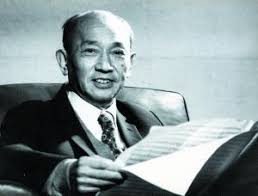
The Chinese composer Ding Shande (1911–1995) was interested in music from a very young age. He studied traditional Chinese instruments, including the pipa, and Chinese music. He attended the Shanghai School of Music and began piano studies. This was when he was introduced to European classical music, in particular Russian music. He began composition studies with Arthur Honegger and Nadia Boulanger at the Paris Conservatoire Nationale Superieur de Musique when he was in his 30s.
Ding’s music often contains Chinese themes or variations on Chinese folk songs. He would travel around China to remote provinces to draw inspiration from the terrain and people. Xu Zhou said, “As an innovative composer, Ding’s experiments in combining various and bold musical materials with Chinese traditional styles became the model for contemporary Chinese composers and those of the next generation.”
Ding’s Long March Symphony (1962) is in five movements: I. Embarking on the Road; II. Red Army, The Beloved of the Various Nationalities; III. Rush Capture of the Luting Bridge; IV. Crossing Snow Mountains and Grassland; and V. Triumphant Junction. The composer said, “I finished my composition the Long March Symphony in 1962, after working for some three years from the original conception to writing the last notes of the score. Throughout this period it was the Long March itself, the amazing achievement of the Chinese Worker’s and Peasants’ Red Army over a distance of 25,000 miles, that was the powerful driving-force urging and encouraging me on.” Ding spent two years visiting all of the areas along the route of the Long March, collecting folk songs from the regions to use in the symphony. The Long March Symphony is considered to be one of the greatest Chinese symphonies in the repertoire.
My classical music post for today is Ding Shande’s Long March Symphony.


Leave a Reply