

William Cosgrove famously said, “Music hath charms to soothe a savage breast.” At this pivotal moment in the world’s history, the Daily Classical Music Post explores music by composers who ran afoul of tyrants and dictators and who as a result were banned, imprisoned, or executed. We’ll also listen to some music by composers who criticized the regime under which they worked but managed to fool the ruler.
Bologne: Symphony in G Major, op. 11, no. 1: I. Allegro | Tafelmusik
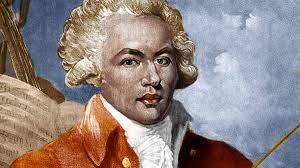
The movie Chevalier introduced many people to the music of the French composer Joseph Bologne (1745–1799). Bologne, son of a wealthy white plantation owner and and enslaved Black woman from Senegal, was born on the island of Guadeloupe but moved to France as a child and was sent to school in northern France. He excelled at fencing as well as music; his successes in fencing earned him the rank of chevalier (equivalent to that of a knight), and thereafter he was known as the Chevalier de Saint-Georges.
Bologne’s success as a musician began almost as soon as he began his studies at the age of 7. His violin playing and his compositions were lauded. In the 1770s, he nearly became head of the Paris Opéra; however, his appointment was prevented by a group of people who said that they would never respect or “submit to orders of a mulatto.” After that, it became more difficult for Bologne to get his music performed, and although he had enjoyed royal patronage for many years, this also evaporated. In 1789, he led the first all-Black regiment in the French Revolution, a post that led to his arrest and imprisonment. He did return to music after he was released from prison, but he died not many years after that.
He might not have been forgotten until the 21st century, however, were it not for Napoleon Bonaparte. In 1802, Bonaparte reinstated slavery in France and also issued an order to destroy as much of Bologne’s music as could be found. Jordan Williams said, “Since Joseph’s music would have been significant in banding together Black communities through musical empowerment, Napoleon would have worked to ban his music to keep Joseph’s accomplishments and talent as a Black man hidden from the world. As such, much of Joseph Bologne’s music was lost and forgotten in the centuries since his death.”
Fortunately, not all of Bologne’s music was destroyed, and what is extant reveals a composer who was one of the leading musicians of the Classical era as well as a pioneering composer. K. Dawn Grapes said, “Saint-Georges’s Symphony No 1 in G Major is a pristine example of the early classical symphony. Composed in the late 1770s, it was premiered by the Concerts des Amateurs and published as opus 11, alongside the composer’s second symphony. Written for strings plus pairs of oboes and horns, the music is charming and balanced throughout its three movements. The first violins dominate the musical conversation while the lower strings provide rhythmic momentum. The winds lend harmonic support and timbral variety.”
My classical music post for today is Joseph Bologne’s Symphony No. 1 in G Major: I. Allegro.


Leave a Reply