

William Cosgrove famously said, “Music hath charms to soothe a savage breast.” At this pivotal moment in the world’s history, the Daily Classical Music Post explores music by composers who ran afoul of tyrants and dictators and who as a result were banned, imprisoned, or executed. We’ll also listen to some music by composers who criticized the regime under which they worked but managed to fool the ruler.
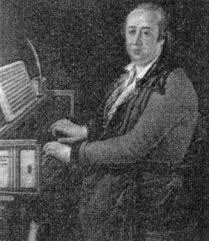
The Italian composer Domenico Cimarosa (1749–1801) was born and spent most of his working life in Naples, although his fame as an opera composer led to work at opera houses and royal courts throughout Europe. He also was court composer to Catherine the Great of Russia from 1787 to 1791. He returned to Naples during the French Republic occupation in 1799 and joined the liberal party opposing the monarchy; unfortunately, that turned out to be a mistake. When the monarchy was restored later that year, he was arrested and imprisoned for four months. He was actually sentenced to death, but some influential people who admired his music interceded on his behalf, and he was released. The terms of his release meant that he had to leave Naples, so he went to Venice, where he died less than two years later.
Most of Cimarosa’s operas were comedies, although he did write some serious ones, as well as some instrumental and church music. Jennifer Johnson said, “One of Cimarosa’s strengths was the composition of witty and vivacious ensembles. Il matrimonio segreto, an ensemble opera in the style of Mozart’s Le nozze di Figaro, is composed of eight arias, four duets, three trios, a quartet, a quintet and two finales featuring all six characters.” Although Cimarosa was fairly staid harmonically, he was an innovator when it came to form. He was greatly admired in his lifetime, and many consider him to be the greatest Italian composer of opera until Gioachino Rossini.
Although Il matrimonio segreto is thought to be his masterpiece, apparently he thought his best work was the serious opera Artemisia, regina di Caria (1797). After he was released from prison, he began work in Venice on another opera also called Artemisia. Simone Perugini said, “The ‘serious drama for music’ Artemisia was composed by Cimarosa on commission from Alberto Cavos, impresario of the Teatro La Fenice in Venice where it was performed on 17 January 1801, seven days after the composer’s death. Originally conceived by the librettist Giovanni Battista Colloredo (who signed the libretto with the Arcadian pseudonym of Cratisto Jamejo) in three acts—and thus printed in the libretto prepared for the first performance—it was presented to the public in a two-act reduction on the day of its debut.” Cimarosa’s overtures were always composed separately from the rest of the operas, and so bear no relation thematically to anything in the actual opera. The overture to Artemisia is a typical Cimarosa crowd-pleasing curtain-raiser, a very enjoyable way to spend about nine minutes.
My classical music post for today is Domenico Cimarosa’s Artemisia: Overture.


Leave a Reply