

William Cosgrove famously said, “Music hath charms to soothe a savage breast.” At this pivotal moment in the world’s history, the Daily Classical Music Post explores music by composers who ran afoul of tyrants and dictators and who as a result were banned, imprisoned, or executed. We’ll also listen to some music by composers who criticized the regime under which they worked but managed to fool the ruler.
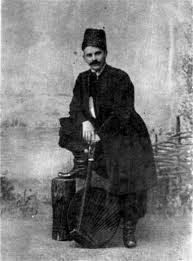
Гнат Мартинович Хоткевич грає жартівливу пісню “Кисіль” (народня бандура). Уповільнений запис. 1936
The Ukrainian Renaissance man Hnat Martynovych Khotkevych (1877–1938) was one of the many “Executed Renaissance” artists, writers, and musicians imprisoned, tortured, and killed during the Great Purge (also known as the Great Terror) that took place from 1936 to 1938 in the Soviet Union on the orders of Joseph Stalin. Khotkevych, a composer, musicologist, violinist, pianist, baritone, bandurist, and teacher, as well as author, playwright, and engineer, was first persecuted in the 1890s by the Russian tsar and authorities because of his association with Ukrainian culture and the bandura, and then later by the Soviet authorities for pretty much the same reasons.
Khotkevych is considered to be the father of the modern bandura, a Ukrainian plucked-string instrument that is somewhat similar to the zither and the lute. Many people consider the bandura to be the national instrument of Ukraine; there was a long rich history of bandura players, many of them blind, travelling and playing throughout the country. Because of its association with the Ukrainian language and history, bandurists were routinely arrested and executed by Russian and Soviet authorities (and later by the Nazis). In 1935, approximately 300 street musicians from all over the country, most of them blind bandurists, were invited to attend what was purported to be a conference in Kharkiv. All of them were subsequently executed.
Khotkevych designed an asymmetrical bandura in 1894, increasing its range. He wrote the first bandura handbook (1909) and also was the first to have a work for the bandura published. He also prepared books on Ukrainian folk instruments and folk music, although many were not published because of the persecution he faced. He was exiled in the early 1900s, and although he returned to Ukraine in the 1920s, it wasn’t long before the persecution began again. His music was banned in the early 1930s, and he was executed in 1938. Although he was posthumously “politically rehabilitated” by the Soviets in the 1950s, much of his work has yet to be published or performed.
In 1936, Khotkevych performed a bandura song, “Kysil,” in the film Nazar Stodolya (1936). This is very likely the only surviving footage of this extraordinary man, and it is exciting to hear this wonderful instrument played by a true master. The bandura is definitely “the sound of Ukraine.”
My classical music post for today is Hnat Martynovych Khotkevych performing “Kysil.”


Leave a Reply