

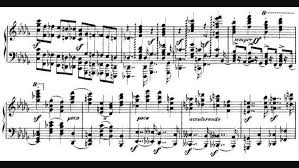
The first work of a classical composer can provide a glimpse of who that composer will become, or it can seem as if it was written by a totally different musician. This November, the Daily Classical Music Post has explored some first works (or Op. 1 works, not always the very first work) by composers familiar and unfamiliar.
Wilhelm Stenhammar : Concerto No. 1 in B-flat minor for piano and orchestra Op. 1 (1893)
The Swedish composer Wilhelm Stenhammar (1871–1927) initially was a great admirer of German composers, particularly Richard Wagner and Anton Bruckner, but he later wanted to celebrate his Nordic heritage and so distanced himself from German influences. His later works are more like those of Carl Nielsen and Jean Sibelius.
Stenhammar was considered to be the finest Swedish pianist of his generation, so it is no surprise that his Op. 1 was a piano concerto. The Piano Concerto No. 1 in B-flat minor was composed in 1893, around the same time as he began work on his opera Gillet på Solhaug, which wasn’t completed until 1896. Andrew Manze said, “The twenty-two year old’s Opus 1 is a masterpiece, majestic and virtuosic at its opening; bringing the listener into a world of Nordic mystery at the start of the third movement; the finale ending with music of sad, reflective sweetness.” Stenhammar premiered his first piano concerto in Stockholm in an all-Swedish programme, and it immediately became popular throughout Europe.
Robert Layton said, “In time, however, [Stenhammar] grew tired of the concerto and became careless as to its fate. On every occasion he played it, what we have hitherto thought of as the only copy of the score and parts was despatched from Breslau by his German publisher and then returned, and even when the parts once went astray after a performance (they eventually turned up in Norway), Stenhammar made no special effort to have a copy made. Both the autograph and the orchestral parts were destroyed during the Second World War but the piano score and a short score survived, and Kurt Atterburg, who had heard Stenhammar play the work several times, reconstructed the orchestral part from memory.” Much later, a copy of Stenhammar’s original score was discovered in the Library of Congress, probably created for the U.S. premiere of the work.
The Piano Concerto No. 1 was not actually Stenhammar’s first work, although it was the first to be published and assigned an opus number. His first composition, later published as Op. 3, was a piece for baritone and orchestra, Florez och Blanzeflor, which was written in 1891 to a text by the Swedish poet Oscar Levertin. It’s not entirely clear why he chose to publish the piano concerto first; perhaps as he was a pianist, he just wanted that to be his first success. There actually was another until recently unknown work from late 1891, Prélude and Bourrée for orchestra. Richard Whitehouse said, “Although Stenhammar seems to have intended a larger suite, further movements never materialized.” That may be the reason why it was not published before the Piano Concerto No. 1, either.
My classical music post for today is Wilhelm Stenhammar’s Piano Concerto No. 1, Op. 1.


Leave a Reply