

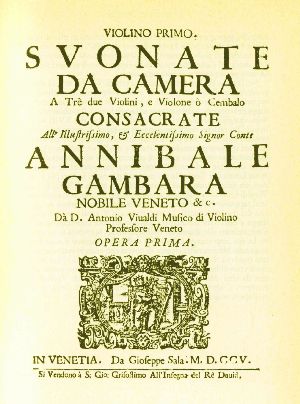
The first work of a classical composer can provide a glimpse of who that composer will become, or it can seem as if it was written by a totally different musician. This November, the Daily Classical Music Post will explore some first works (or Op. 1 works, not always the very first work) by composers familiar and unfamiliar.
Sonata “La Follia” Op. 1 n. 12 RV 63
The Italian composer Antonio Vivaldi (1678–1741) is best known for The Four Seasons, but he composed much more than that piece, including sacred choral works, more than 50 operas, and many other instrumental concertos. He was very popular for most of his life, but in his later years he fell into disfavour. He died in poverty, having sold off most of his manuscripts to be able to afford to live. It wasn’t until the early 20th century that he was “rediscovered” and his music was performed regularly again.
Vivaldi’s Op. 1, unsurprisingly, was a set of 12 trio sonatas for two violins and basso continuo. Federico Guglielmo said, “The period in which Vivaldi was perfecting his virtuoso violin technique coincided with the years in which he wrote his first instrumental compositions. In those days the first work a composer had printed often represented not only proof of maturity and membership of the circle of composers, but also the most corrected and perfected of a lifetime’s publications. Indeed, the first printed edition was often postponed until the composer felt he had reached the desired standard of quality. . . . It is almost certain that Op.1 in the extant 1705 edition was not the first version of the work, but rather a reprint based on an earlier edition published between March and September 1703.”
The final sonata in Op. 1 is known as “La Follia” because it is a set of variations on the famous European tune “Folia,” which originated on the Iberian Peninsula some time in the 15th century. Nicholas Kenyon said, “[H]is amazing Op 1, published in Venice, [shows] a complete contrapuntal control of the trio sonata form, building on Corelli’s achievements.” Roderic Dunnett said, “By 1703 Vivaldi had attained a level of musical artistry that, matched by his extraordinary sensibility, would make one assume these, including the wonderfully dynamic La Folia variations (no.12), were written in his later years.”
My classical music post for today is Antonio Vivaldi’s Sonata Op. 1 No. 12, “La Follia.”


Leave a Reply