

Politics can shape music just as music can express political ideas. This October, the Daily Classical Music Post will look at some of the music written as a protest, commemoration, or statement of political beliefs.
Mary Kouyoumdjian: Silent Cranes (iv. you flew away): Kronos Quartet, L. Olinder, D. Barsamian
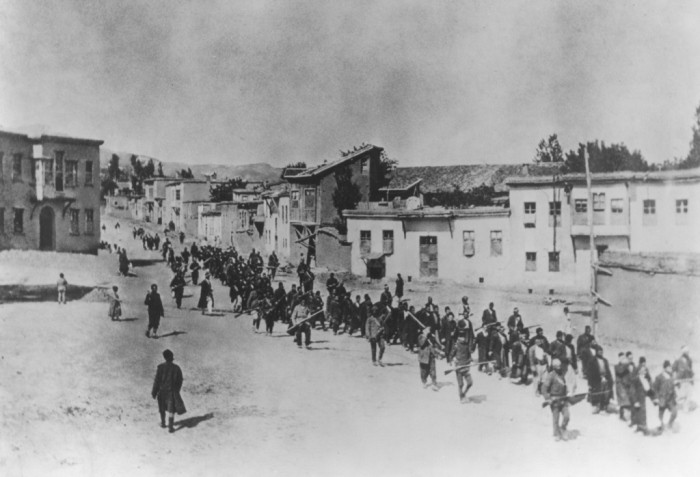
The Armenian Genocide took place in the Ottoman Empire in 1915 and 1916. Estimates of Armenians killed range from around 660,000 to over 1.2 million. The U.S. Holocaust Memorial Museum webpage on the Armenian Genocide says, “The victims of the Armenian genocide include people killed in local massacres that began in spring 1915; others who died during deportations, under conditions of starvation, dehydration, exposure, and disease; and Armenians who died in or en route to the desert regions of the southern Empire. . . . In addition, tens of thousands of Armenian children were forcibly removed from their families and converted to Islam.”
The Armenian-American composer Mary Kouyoumdjian (born 1983) says on her website, “As a first generation Armenian-American and having come from a family directly affected by the Lebanese Civil War and Armenian Genocide, she uses a sonic palette that draws on her heritage, interest in music as documentary, and background in experimental composition to progressively blend the old with the new. A strong believer in freedom of speech and the arts as an amplifier of expression, her compositional work often integrates recorded testimonies with resilient individuals and field recordings of place to invite empathy by humanizing complex experiences around social and political conflict.”
In 2015, the Kronos Quartet commissioned Kouyoumdjian to compose a work commemorating the Armenian Genocide Centenary. Silent Cranes, in four moments for amplified string quartet, audio playback, and live processing, premiered in May 2015. The programme notes said, “Silent Cranes is inspired by the Armenian folk song Groung (Crane) in which the singer calls out to the migratory bird, begging for word from their homeland, only to have the crane respond with silence and fly away. Those who were lost during the genocide are cranes in their own way, unable to speak of the horrors that happened, and it is the responsibility of the living to give them a voice.”
My classical music post for today is Mary Kouyoumdjian’s Silent Cranes: iv. you flew away.


Leave a Reply