

Politics can shape music just as music can express political ideas. This October, the Daily Classical Music Post will look at some of the music written as a protest, commemoration, or statement of political beliefs.
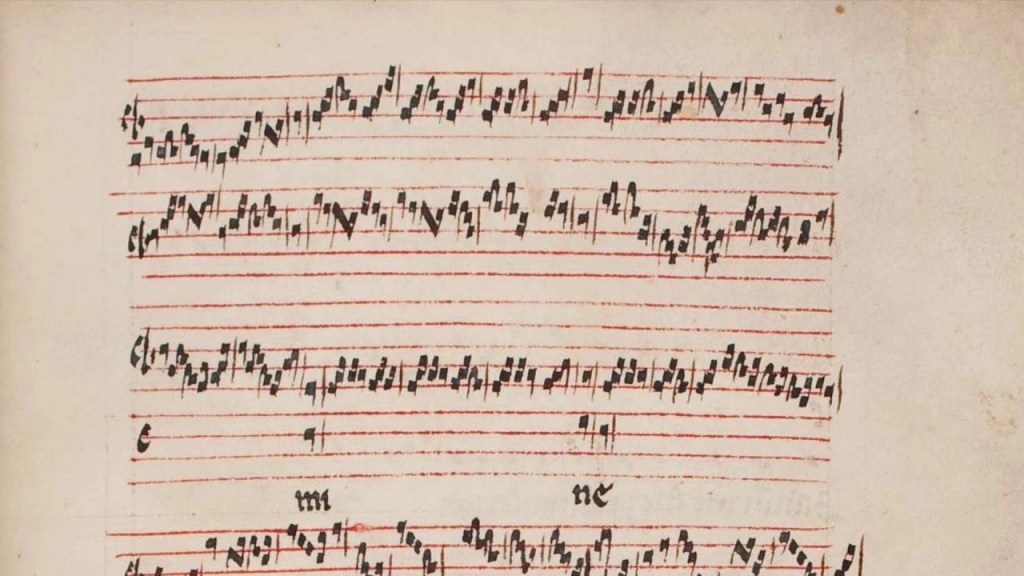
Perotin – Organum quadruplum “Sederunt principes” (ca.1200)
The ars antiqua composer Perotinus (also known as Pérotin; fl. c. 1200) is presumed to have been French, although so little is known about his life that no one is entirely sure where he was from. What is known is that he was the first Western composer to write for three and four voices. His compositional style was a major shift towards true polyphony, as before his innovations, organum was monophonic and for no more than two voices.
Sederunt principes was most likely composed for St Stephen’s Day. The text is ostensibly about relying on God to save the listeners from persecution, as St Stephen did, but there is a subtext. Perotinus was protesting against the power of the nobility, as can be seen in the text, taken from two different Psalms: “The princes sat, and spoke against me: / they have persecuted me unjustly. / Do thou help me, Lord my God: / Save me for thy mercy’s sake.”
Sederunt principes is an exciting example of how a master ars antiqua composer used multiple interweaving melodic lines to explore harmony and counterpoint. The wall of sound created through intricate layering is inspiring, and listeners in the congregation would have identified with the sentiments expressed. David Fallows said, “The work is quite exceptionally minimalist in its restraint, its gentle onward flow, its almost obsessive concentration on a very small number of chords, its glorious canvases generated from so little material.”
My classical music post for today is Perotinus’ Sederunt principes.


Leave a Reply