

Composers dedicate pieces of music to others for many reasons. Sometimes it is a way to thank or honour a mentor or patron. Sometimes it is to express friendship or love interest. Maybe the composer wants to remember someone close to them who has died. And maybe it’s just to celebrate a favourite place or event. This September, the Daily Classical Music Post is introducing you to a selection of works with dedications.
Sarasate: Eight Spanish Dances
The Spanish composer Pablo de Sarasate (1844–1908) was well known as a violinist and conductor as well as a composer. George Bernard Shaw once said of Sarasate that although there were many composers of music for the violin, there were very few composers of violin music. GBS also was extremely impressed by Sarasate as a performer; he said that Sarasate “left criticism gasping miles behind him.” Sarasate’s works are virtuosic crowd-pleasers and often are played as encores.
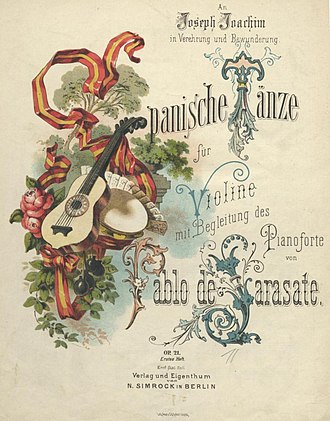
The German publisher Fritz Simrock was looking for a collection of Spanish dances for violin, and so in 1877 Sarasate was commissioned to write eight pieces. Book I, Op. 21 was composed in 1877/78, Book II, Op. 22 in 1878, Book III, Op. 23 in 1879, and Book IV, Op. 26 in 1881. Each book was dedicated to a different violinist: Joseph Joachim, Wilma Neruda, Hugo Heermann, and Leopold Auer, respectively.
Chu-Yunn Lee said, “His eight Spanish Dances, Introduction and Tarantella, Romanza Andaluza and Zigeunerweisen, are considered representative repertoire and show strong Spanish influences in their rhythms and harmonies. They illustrate the scope and limitations of his technical and musical characteristics.” Beatriz Pomés Jiménez said, “[T]he majority of Sarasate’s compositional activity was inspired by Spain’s popular dances and folk music traditions. . . . The result is a rich and varied set of charming Spanish Dances that constitute a simple and accurate translation of Spanish popular songs and dances.”
My classical music post for today is Pablo de Sarasate’s Eight Spanish Dances.


Leave a Reply