

This July, the DCMP will share some previous posts that you might have missed or would just like to hear again! A new theme begins in August.
Published September 27, 2015
Today is the anniversary of the birth of the English composer Cyril Scott (27 September 1879–31 December 1970).
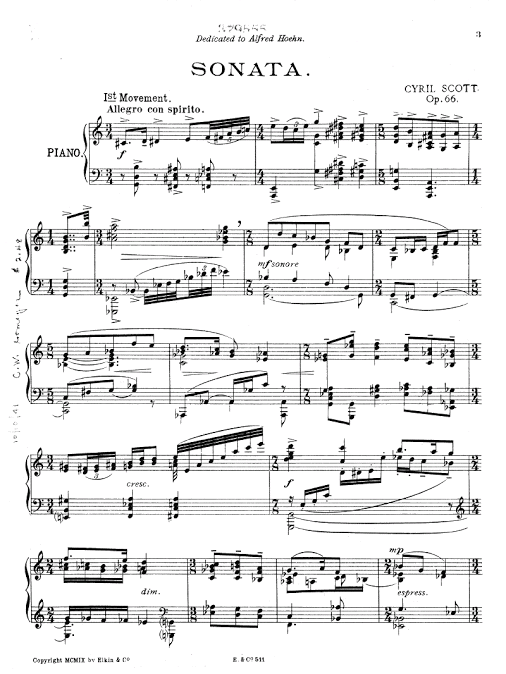
Piano Sonata No. 1, Op. 66: 1. Allegro con spirito
Eugene Goossens called Scott “the father of modern British music” — and I’ll bet you’ve never heard any of Scott’s music. Scott was an extraordinarily gifted musician, and he experimented with many things, most particularly free rhythm and musical harmonies. He was admired by many other composers, including Debussy, Ravel, Grainger (who was one of his closest friends), Strauss, and Stravinsky.
Scott wrote more piano works (he was a talented pianist as well, which I’m sure helped) from 1903 to 1914 than any other composer in the world, save Scriabin. His experiments in harmonies influenced no less a composer than Elgar, who claimed that the daring harmonies that he used in his Second Symphony were not his idea: “You mustn’t forget, it was Cyril Scott started all that!”
In 1909, Scott wrote his Piano Sonata No. 1 Op. 66. This is an absolutely incredible piece: every bar is in a different metre, which gives the work a freedom as well as a sometimes improvisatory air. If you listen carefully, you can hear little snippets of folk music, but Scott has interwoven this with his “free association” harmonies so that the musical language is all his own. I think that Scott could have left the bar lines out completely; maybe that was one innovation too far for him?
There is a wonderful letter written by Percy Grainger to the young Scottish composer Ronald Stevenson in which he mentions this Piano Sonata:
“Dear Ronald Stevenson,
“I found your article on Busoni very stimulating. It brought clarity into my thoughts about Busoni. When I first met him, in 1903, when he offered to give me piano lessons without payment, it was the originality of my sketches for Scotch Strathspey & Reel that attracted him.
“By 1907 he had soured on me, but when we played thru the 2-piano version of Hill-Song No. 2 his hostility melted & he said, quite wistfully: ‘Das ist ein hübsches stück – das ist ein hübsches stück!’
“And of course I talked to him of the various innovations I had already tried-out (irregular rhythms, unresolved discords, large chamber-music, etc.) or intended to try-out in the future (close intervals, gliding tones, etc.). And while I am not denying that he may have got his ‘music of the future’ from all sorts of sources I do suggest that he got enough from me to account for his ideas of music to-come.
“It was the same with Stravinsky & Schoenberg. Neither of these superb geniuses developed their iconoclastic innovations until my innovations, as incorporated in the Cyril Scott Piano Sonata Op. 66 (incorporated by C. Scott with full written permission by me) had been freely played & heard in Central Europe around 1908 – my ‘unresolved discords’ of 1898 leading to atonalism, my irregular rhythms of 1899 leading to irregular rhythms of ‘Sacre du P.’ And when the 1st German War cut off compositional contact between Britain & Central Europe, what happens: These 2 geniuses dropped their British-rooted innovations & went back to less progressive stimulations. (Neither Cyril Scott or I have ever dropped our innovations.) Almost everything that European man does had an English-speaking origin: 5 o’clock tea, train, tram, steamer, flirt, bus, strike, lock-out, club, sandwich, lunch, golf, sport, skyscraper, chewing-gum, maxim-gun, revolver, etc. So why should it be otherwise in music? Is it not a fact that most musical innovations are English-speaking (according to the musicologists): Foweles in the Frith, Worcester Medieval harmony, Dunstable, William Lawes, Jazz? So if an English-speaking composer happens to invent, or revise (for of course Claude Le Jeune also had his irregular rhythms), or transform some aspects of music, why should it seem so unthinkable that it cannot be mentioned?”
Grainger definitely was a pioneer in the use of free rhythms, but Scott was able to take this one step further in the Piano Sonata No. 1 Op. 66 and incorporate his own harmonies and musical ideas, making it an incredibly exciting (and, for the time, daring) work.
After World War I, Scott’s music fell out of favour, and it has only recently been “rediscovered” with new recordings and performances.
My classical music post for today is the first movement of Cyril Scott’s Piano Sonata No. 1 Op. 66. It is performed by the great Australian pianist Dennis Hennig, who had planned to record all of Scott’s piano works. Unfortunately, Hennig died young, and only released two CDs.


Leave a Reply