

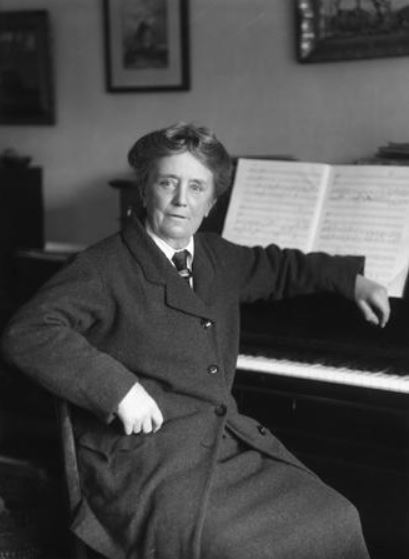
This June, the Daily Classical Music Post celebrates Pride Month by listening to music written by LGBTQIA+ composers throughout history.
The English composer and suffragist Dame Ethel Mary Smyth (1858–1944) had enormous fights with her father regarding her desire to study music. Eventually he relented, and she attended Leipzig Conservatory, studying composition with Carl Reinecke. As she noted in her memoirs, there was a “lack of musical enthusiasm” among the other students, which she ascribed to “the atmosphere of superficiality and indifference our masters distilled.” She described her lessons with Reinecke as “rather a farce” and so left the Conservatory after a year to study privately with Heinrich von Herzogenberg, through whom she met Clara Schumann.
Smyth composed in many different genres. Her opera The Wreckers has been called the “most important English opera composed during the period between Purcell and Britten.” In 1903, her opera Der Wald was the first opera composed by a woman to be performed by the Metropolitan Opera in New York.
Sophie Fuller said, “Smyth was also defiantly queer, as open as anyone of her generation could be about the intense, and sometimes sexual, relationships with women that drove so much of her often-turbulent life. Many of these women were, and still are, well known: the Parisian music patron Winaretta Singer, the Princesse de Polignac (1865–1943); leader of the suffragette movement Emmeline Pankhurst (1858–1928); writers Edith Somerville (1858–1949) and Virginia Woolf (1882–1941), to name just a few. As Smyth herself wrote in her memoirs Impressions That Remained: ‘My relations with certain women, all exceptional personalities I think, are shining threads in my life’.”
Smyth’s Mass in D (1889) is set for soloists, chorus, and orchestra. Composition of the Mass came after Smyth renewed her High Anglican beliefs. Queen Victoria and Alfred, Duke of Edinburgh heard part of the Mass and asked the Royal Choral Society to premiere the entire work, and this happened on 18 January 1893 in the Royal Albert Hall. Linda J. Farquharson says, “The Mass in D is an extension of Smyth’s personality—powerful, colorful, and gifted.”
My classical music post for today is Ethel Smyth’s Mass in D.


Leave a Reply