

“The world’s favorite season is the spring.”—Edwin Way Teale
Alexander Glazunov – Spring, musical picture for orchestra, Op. 34
The late Romantic Russian composer Alexander Glazunov (1865–1936) was a bit of a character. Stories abound of his conducting concerts while drunk. According to Shostakovich, Glasunov had a bottle of alcohol (vodka, perhaps?) behind his desk and would sip it through a tube while teaching. It was widely accepted that although he was a top-notch composer and teacher, conducting was not his forte at all. He apparently once said, “You can criticize my compositions, but you can’t deny that I am a good conductor and a remarkable conservatory Director.” (I think that was meant to be a joke.)
He certainly was highly regarded as a composer in his lifetime. Strangely, though, when he died in France at the age of 70, people were quite surprised, as they thought that he had been dead for a while. That was possibly because much of his music was closer in style to the composers who came before him—for example, his mentor Rimsky-Korsakov and Borodin—than to those whom he taught, including Shostakovich and Prokofiev.
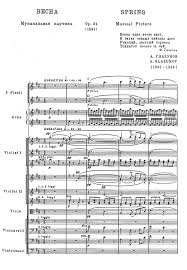
Glazunov’s “symphonic picture” Vesna (The Spring), Op. 34 (1891) is a good example of his early style. The title page of the original score includes an excerpt from a poem about spring by Fyodor Tyuchev (“Spring is coming, and the luminous choir and gentle days of May joyfully follow”). Vesna is a gentle piece, just right for a lovely May morning.
My classical music post for today is Alexander Glazunov’s Vesna.


Leave a Reply