

Chamber music, sometimes described as “the music of friends,” is generally used to refer to music composed for a small group of instruments or voices, with one performer to a part. The intimacy of chamber music makes it a perfect genre for compositions marking important events or for unusual combinations of instruments. This April, the Daily Classical Music Post will introduce you to some of these very special works.
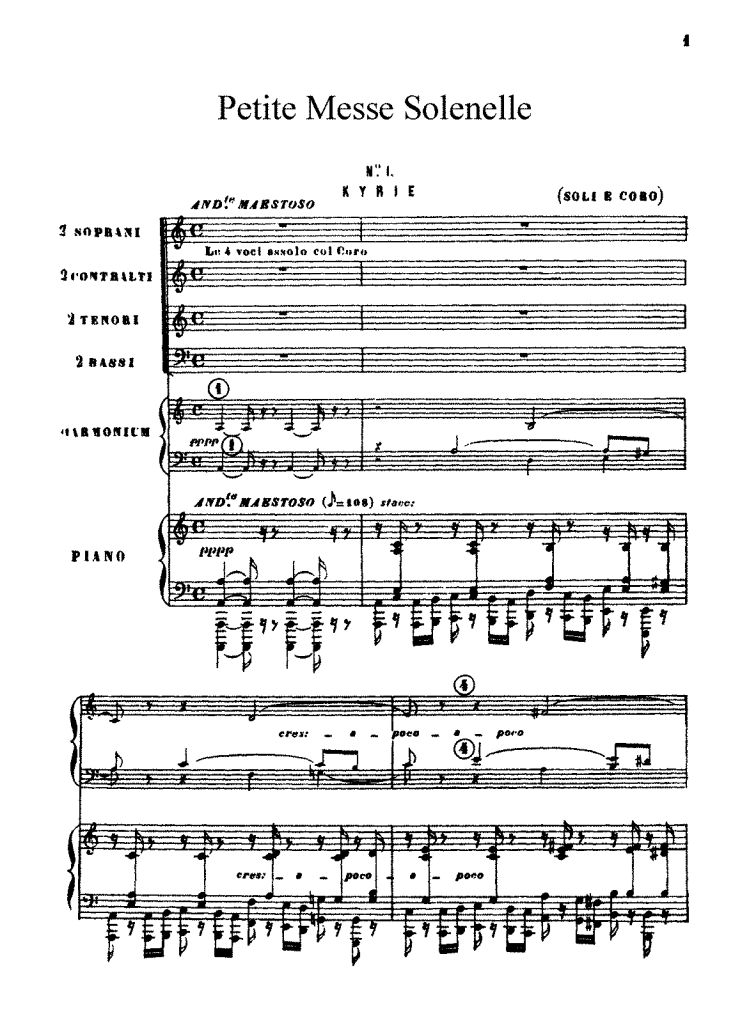
Petite messe solennelle (Chamber Version) : I. Kyrie
The Italian composer Gioachino Rossini (1792–1868) originally wrote his Petite messe solennelle for just 12 singers (four soloists), two pianos, and harmonium. Most scholars agree that this work was composed for Count Alexis Pillet-Will, and the first performance took place in 1864 at the Count’s house in Paris. The later orchestral version is the one that most people know, but the chamber version is marvellously intimate and has an immediacy that the one for larger forces just does not have.
Rossini was a bit of a wag, and on the last page of the manuscript score, he wrote, “Dear Lord, here it is finished, this poor little mass. Have I just written sacred music, or rather, sacrilegious music? I was born for opera buffa, as you well know. Not much technique, a little bit of heart, that’s all. Blessings to you and grant me Paradise.” Interestingly, the 12 singers were, according to a note by the composer on the second page of the score, meant to be “singers of three sexes, men, women, and castrati.” Rossini never heard the full orchestral version as during his lifetime, women were not allowed to sing in churches, and he specifically wanted women’s voices as part of the choir and soloists.
Dan Davis said, “If you’re not familiar with this odd masterpiece, your first reaction is likely to be surprise—a ‘petite’ mass more than 80 minutes long, a small chamber chorus and soloists accompanied by two pianos and, of all things, a harmonium. But after the first shock, this late work by Rossini, written when he was 72, becomes an addictive pleasure. Like everything he wrote it’s bursting with attractive melodies, operatic flourishes, and deep feeling. Occasionally heard in orchestral garb, it’s most effective in its original chamber setting.”
The Petite messe solennelle opens with the Kyrie, which has echoes of earlier church music, particularly Renaissance polyphony, in its rhythm and modulations. The instrumental accompaniment is lovely and light, not unexpected in a work by Rossini. The middle section (“Christe eleison”) is sung a cappella.
My classical music post for today is Gioachino Rossini’s Petite messe solennelle: Kyrie.


Leave a Reply