

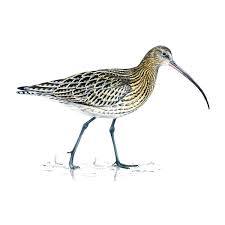
Chamber music, sometimes described as “the music of friends,” is generally used to refer to music composed for a small group of instruments or voices, with one performer to a part. The intimacy of chamber music makes it a perfect genre for compositions marking important events or for unusual combinations of instruments. This April, the Daily Classical Music Post will introduce you to some of these very special works.
Peter Warlock – The Curlew (Ian Partridge, Music Group of London) (vinyl: Sonus SPM4, Sony PS-X600)
Peter Warlock was the pseudonym for the British composer and music critic Philip Heseltine (1894–1930). Warlock was notorious for his tough attitude as a music critic as well as for his often scandalous lifestyle (there were stories of naked motorcycle rides through the English countryside, for example, as well as alcohol-fuelled debauched parties). He was one of the strongest proponents for the rediscovery of early English music. His own music shows influences from a wide range of composers, from early English to Romantic German to 20th-century British and European (particularly Frederick Delius). Much of his output was vocal or choral, set to texts by William Butler Yeats, William Blake, Ford Maddox Ford, William Shakespeare, and many others.
Warlock’s song cycle The Curlew, for an unusual chamber combination of singer and an accompanying group of flute, cor anglais, and string quartet, is set to words by Yeats. Warlock composed this work during one of his most prolific periods, while staying at his family home in Wales, and it is considered to be one of his best compositions.
John Steane said, “When [Warlock is] ‘down’, boy is he down. Down, he is desolate. . . . In The Curlew he is chilled to the bone. . . . The power of those bleak settings lies in the tension that exists between the feeling of the inner heart of the poet-singer and the desolation of the external world (the withered boughs, the wind that cries in the sedge) represented by the accompanying instruments, especially the cor anglais.” Angela Wirbiezcas said, “There are clues hidden in the music to indicate that a story is presumably being told of someone, in this case the tenor, receiving bad news in the form of a birdcall in Song one, the tenor clarifying the details of the bad news in Song two, the tenor slipping into a temporary sleep or dream-like state as an escape in Song three, and then waking and facing reality in Song four.”
The Curlew is made up of four songs. The instruments play a prelude before the poems and interludes in between each, with no breaks. Each instrument has its own role to play. There is no key signature, and the metres are mixed. The flute and cor anglais were chosen by Warlock specifically for their abilities to sound like birds, the curlew and the peewit in particular.
My classical music post for today is Peter Warlock’s The Curlew.


Leave a Reply