

The entertainment industry loves biopics. It doesn’t really matter if the details are exaggerated or just plain untrue: all that matters is telling a good story! Biopics about classical music composers and musicians can range from the mostly factual to out-and-out fanciful. This March, the Daily Classical Music Post will look at some of these films.
Maria Callas sings “Vissi d’arte” (from Puccini: Tosca) – Paris, 1958
There are several biopics of famous opera singers; the story of a diva in that glamorous world has appealed to many writers and directors since the dawn of Hollywood. All of the ones that I have seen are fictionalised, some more egregiously than others. Florence Foster Jenkins, arguably one of the worst opera singers to ever walk the Earth, had two wildly different biopics about her released in 2016: one starring Meryl Streep and the other starring an actual really good opera singer, Joyce DiDonato, as the woman with the ego of a diva and the voice of a chainsaw. One of Foster Jenkins’s greatest fans was the opera singer Enrico Caruso, whose 1951 biopic starred Mario Lanza, who was a star of Hollywood musicals and idolised Caruso. The Great Caruso was so fanciful that Caruso’s family successfully sued MGM and had the film banned in Italy.
For many people, however, the most mysterious and intriguing opera singer of all time was the Greek soprano Maria Callas (1923–1977). Her extraordinary voice, her tumultuous relationship with the Greek shipping magnate Aristotle Onassis, and her fiery emotions led F. Paul Driscoll and Brian Kellow to say, “Nearly thirty years after her death, she’s still the definition of the diva as artist—and still one of classical music’s best-selling vocalists.”
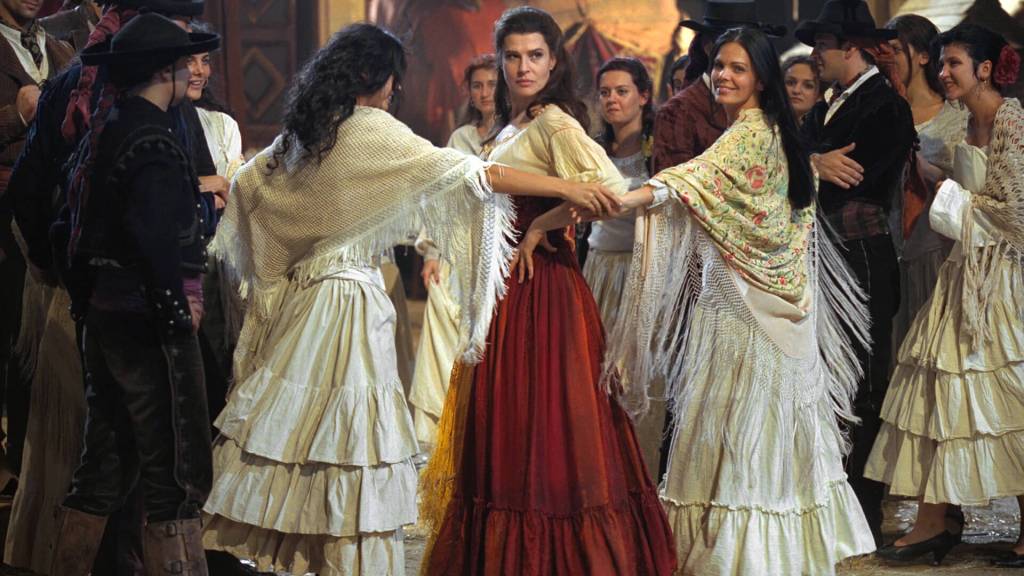
Callas as a character appears in many books, stage plays, films, and fictional stories, and she of course received the biopic treatment more than once. One of the most well-known is Franco Zeffirelli’s 2002 Callas Forever, which stars Fanny Ardent as the diva in the last year of her life. An all-star cast includes Jeremy Irons and Joan Plowright. Irons plays Callas’s former manager (a completely invented role), who has the idea that she should star in a film of Georges Bizet’s Carmen. Callas knows that her once-famous voice is in ruins, but Irons has the idea that her voice will be dubbed with an earlier recording. This actually works out quite well for the movie, as Ardent didn’t sing, so her voice was dubbed with . . . Callas’s voice.
The three leads all garnered stellar reviews, but Peter Bradshaw writing in The Guardian said, “The critical concept of ‘so bad it’s good’ is vastly overused in these postmodern days. And yet I have no choice but to revive it. Franco Zeffirelli’s film is a gallant, ghastly fantasy about Maria Callas’s final days in the 1970s. . . . It’s a camp extravaganza of such exquisite awfulness, such unembarrassable silliness, that you watch it hypnotised.”
I could have left that as the last word, but I have to mention here that apparently some time this year the world will be subjected to a new biopic of Callas, Maria, starring Angelina Jolie. The advance blurb for the film says that it is “based on ‘true accounts’ of Callas’ life,” but also that it will tell “the tumultuous, beautiful and tragic story of the life of the world’s greatest opera singer, relived and re-imagined during her final days in 1970s Paris,” so we all know what that means. I think that’s all I will say about this.
My classical music post for today is Maria Callas singing Giacomo Puccini’s Tosca: “Vissi d’arte.”


Leave a Reply