

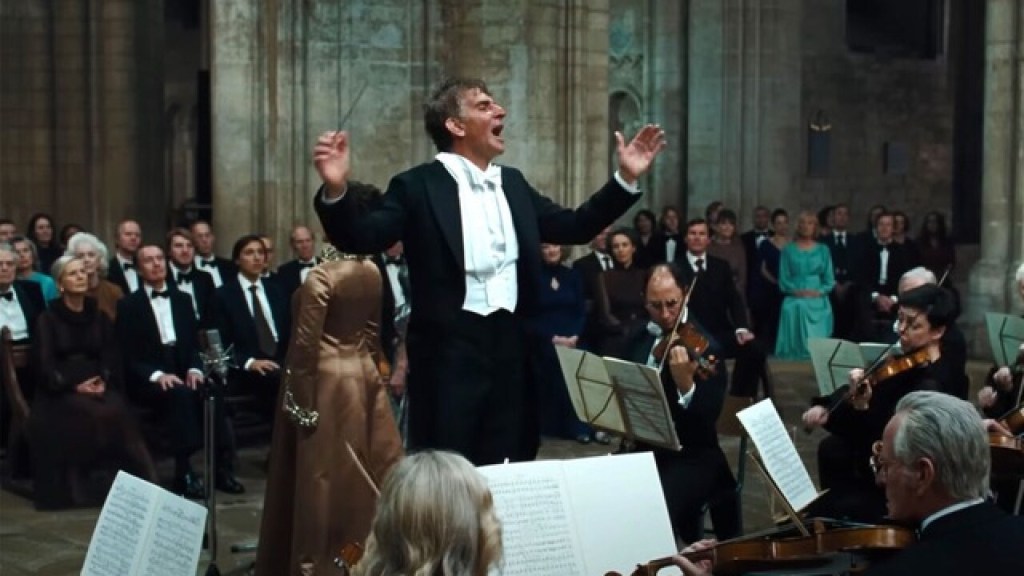
The entertainment industry loves biopics. It doesn’t really matter if the details are exaggerated or just plain untrue: all that matters is telling a good story! Biopics about classical music composers and musicians can range from the mostly factual to out-and-out fanciful. This March, the Daily Classical Music Post will look at some of these films.
A Quiet Place – Act I Postlude
I am going to begin today’s DCMP with a disclaimer: I once played in an orchestra conducted by Leonard Bernstein (1918–1990), and I also even spoke to him (very briefly) once or twice, so as people say today, I was a close personal friend. But seriously, I had admired and, to some extent, worshipped him from afar throughout my teens, and this extraordinary Renaissance man who was a composer, musician, music educator, man about town, poet, conductor, etc etc etc was my idol for many years.
So I approached Bradley Cooper’s portrayal in Maestro of a man I had sort of known with some trepidation. I was already poised to be pissed off when I read about The Nose (no, I am not talking about Shostakovich’s opera). All I will say here is that IMHO the prosthetic added nothing to the performance or the film, and it was a huge mistake.
The decision to make a film about Bernstein’s love life was an interesting one. I do feel, though, that it was all more about how a gay man and a straight woman got married than about an incredible multifaceted and multitalented musician of the 20th century. And, again, for me, anyway, this was not a great decision.
Cooper did not play piano before making Maestro; his hands are seen playing, but in fact the piano music is played by Victoria Ruggiero. Cooper did do a passable impression of an extraordinary conductor, but often while watching him all I could think was of that Tone Deaf Comics cartoon with the conductor thinking “I’m a flappin’ my arms. A flappin’ my arms. A flap flap flap flap flappin’ my arms.”
Cooper decided what music would be in the final film; he chose a variety of works by Bernstein as well as compositions by Ludwig van Beethoven, Gustav Mahler, and Robert Schumann. Cooper said that for him, Bernstein was “punk rock” and he hoped that the film would lead to more people seeking out Bernstein’s music. I am not sure about the first of these things. But perhaps people will want to find out more about works like Bernstein’s only full-length opera A Quiet Place, about which he said, “It sounds like no other work by me or by anybody else I know of . . . It has a special language and sound all its own. The American language has never been treated in this particular way before.”
My classical music post for today is Leonard Bernstein’s A Quiet Place: Act I: Postlude.


Leave a Reply