

The entertainment industry loves biopics. It doesn’t really matter if the details are exaggerated or just plain untrue: all that matters is telling a good story! Biopics about classical music composers and musicians can range from the mostly factual to out-and-out fanciful. This March, the Daily Classical Music Post will look at some of these films.
Gershwin plays Gershwin Rhapsody in Blue (1927)
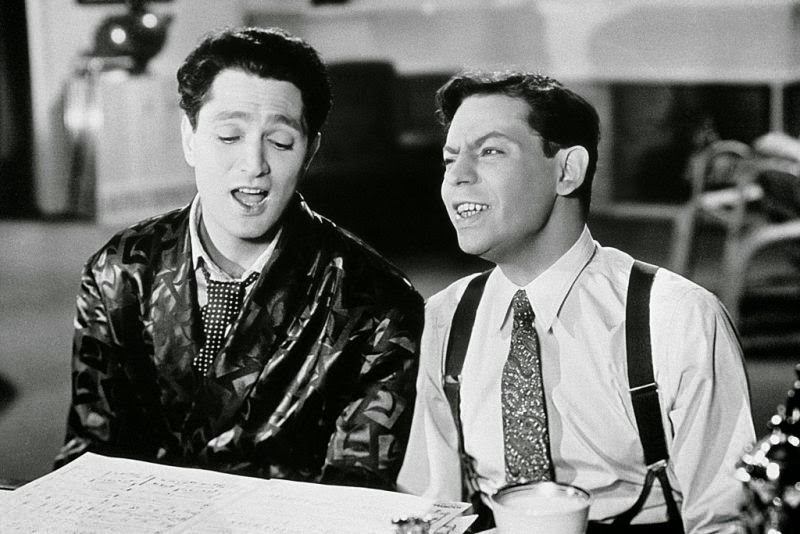
Rhapsody in Blue (1945), starring Robert Alda as the American composer George Gershwin (1898–1937), is a really fascinating biopic. The story of Gershwin’s short life is filled with real-life friends and colleagues playing themselves (including Paul Whiteman, Al Jolson, and Oscar Levant), completely invented love interests, and nearly complete performances of Rhapsody in Blue and An American in Paris (with Oscar Levant dubbing Alda’s piano playing). Most interestingly, two important Black singers with whom Gershwin worked, Anna Brown and Hazel Scott, appear and perform as themselves. Brown created the role of Bess in Porgy and Bess, and she sings “Summertime” (in a strange arrangement) in the film.
Robert Alda was not the first choice for Gershwin; the director, Irving Rapper, wanted to cast Tyrone Power. I remember Power in the earlier Alexander’s Ragtime Band, and I’ll bet he would have been a terrific choice, but Alda does okay. The film was released less than a decade after Gershwin died, so it was kind of gutsy to take on the role of someone highly respected in Hollywood. I only recently discovered that this was Alda’s first screen role. Pretty nifty!
Lloyd Schwartz said, “Hollywood can’t help messing with facts. Gershwin’s brother Ira, who wrote the lyrics to most of George’s songs, is a major character in the film, but their two other siblings are completely expunged. In the movie, George discovers that Ira can write lyrics years after the real Ira started writing them.” The fictitious love interests add nothing to the story except I guess a bit of 1940s eye candy. And the movie is really a bit too long, so they could have left out the made-up love triangle. As an anonymous writer on thebiopicstory.com says, “There is a running joke throughout this film in which Gershwin’s father equates the quality of his son’s compositions with their length. The makers of this biopic appear to be under the same misapprehension.”
In addition to Levant playing the big classical piano works and Brown’s aria, most of the rest of the music is strangely truncated, performed listlessly, and even the main love interest, who is meant to be a singer, has her voice dubbed (like they did so often back then). For a better film of Gershwin’s music with the extremely entertaining Oscar Levant, I’d recommend the Oscar-winning An American in Paris. If you squint just right, you could almost see this as a biopic of Gershwin’s time in Paris!
The link I’ve shared today is of the original recording of Rhapsody in Blue, with Gershwin on piano and Paul Whiteman and His Concert Orchestra, from 1927. It’s really incredible that we have this record of a brilliant musician who never got the opportunity to fulfill his potential. Even this slightly strange biopic makes that very clear.
My classical music post for today is George Gershwin’s Rhapsody in Blue.


Leave a Reply