

The entertainment industry loves biopics. It doesn’t really matter if the details are exaggerated or just plain untrue: all that matters is telling a good story! Biopics about classical music composers and musicians can range from the mostly factual to out-and-out fanciful. This March, the Daily Classical Music Post will look at some of these films.
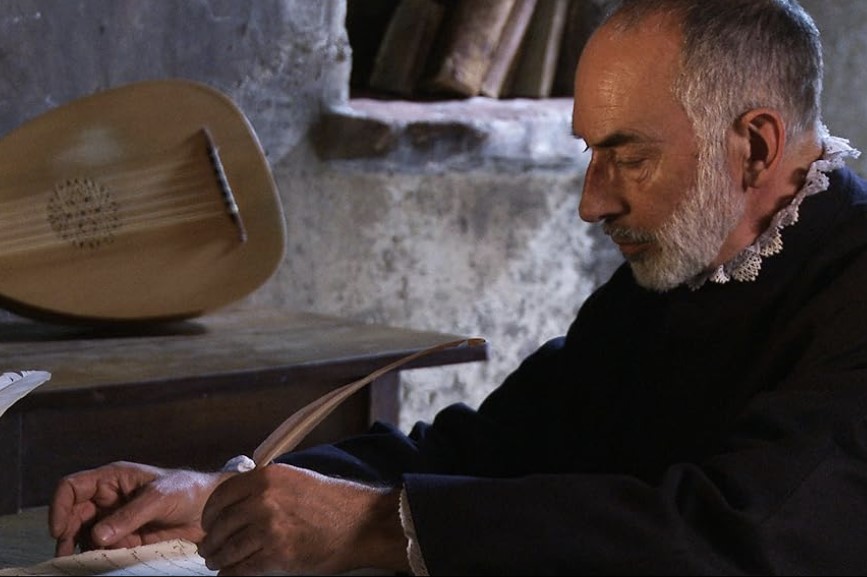
It’s always an interesting decision to begin a biopic with the death of the main subject; how do you then tell their story? The writer-director of the hour-long Italian/German 2009 film Palestrina – Princeps musicae decided to have his surviving son, students, and colleagues talk about their memories of the great Italian Renaissance composer. Giovanni Pierluigi da Palestrina lived from about 1525 to 1594, and as the press release for the film says, “To achieve artistic and economic independence, Palestrina works with great diplomacy in the shadow of the powerful Roman Catholic Church. Despite strict ecclesiastical rules, he succeeds in modernizing music.”
Palestrina really did change the history of music. He developed a polyphonic style that was much more consonant than earlier music. Musicians still study Palestrinas’s style of polyphony, as it pretty much follows some basic guidelines that he established over the course of his career: a dynamic musical flow; few leaps in his melodies; small leaps are countered by stepwise movement in the opposite direction; and dissonances mostly only on weak beats, with those occurring on strong beats resolved immediately. Palestrina also was an innovator in word-setting: for example, the music for words such as “descendit” would be a descending phrase.
The Missa Papae Marcelli is his best-known mass as well as being a prime example of the Palestrina style. For many years, scholars believed that it was composed in response to the possibility that the Council of Trent at their final sessions in 1563 would ban polyphony, but there is no evidence for this. It’s much more likely that the mass, composed in honour of Pope Marcellus II (one of the shortest-reigning popes), was just the work of a brilliant composer who continued to evolve his style throughout his life. Palestrina – Princeps musicae reveals that near the end of his life he married a rich widow whose fortune enabled him to publish his music. This ensured that his music and innovations would not be forgotten.
The music throughout the film is by Palestrina, performed by the Roman Ensemble Seicentonovecento beautifully. Scenes were filmed in and around Rome and L’Aquila only a few days before L’Aquila was mostly destroyed in an earthquake. So the film is both an homage to a great composer and to a beautiful but now mostly lost medieval city.
My classical music post for today is Giovanni Pierluigi da Palestrina’s Missa Papae Marcelli: Gloria.


Leave a Reply