

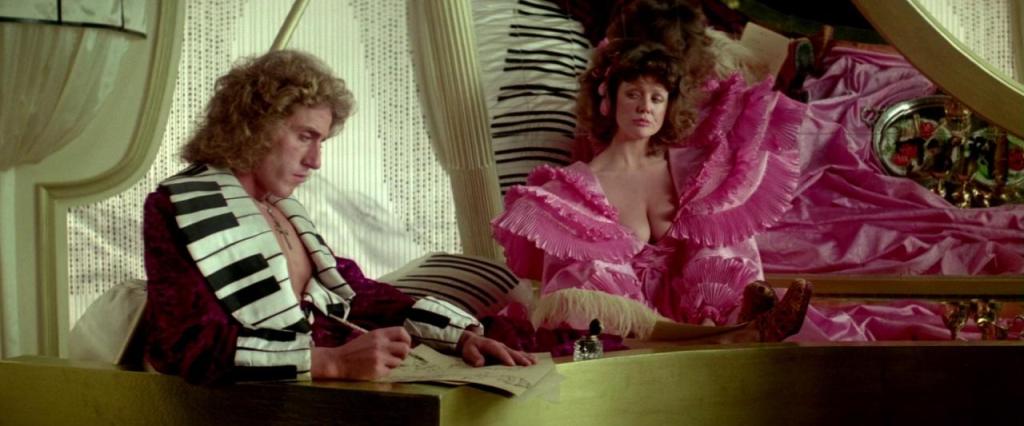
The entertainment industry loves biopics. It doesn’t really matter if the details are exaggerated or just plain untrue: all that matters is telling a good story! Biopics about classical music composers and musicians can range from the mostly factual to out-and-out fanciful. This March, the Daily Classical Music Post will look at some of these films.
Liszt: Liebestraum No. 3, Notturno (Barenboim)
It’s pretty widely known that the Hungarian composer Franz Liszt (1811–1886) was the Tom Jones of his day; yes, women really did throw their undergarments at Liszt, and swooning and fainting were common occurrences at his performances throughout Europe, so much so that the term “Lisztomania” was coined to describe the scenes surrounding his appearances.
So it made absolute and total sense that in 1975 the British film director Ken Russell would make a biopic of Liszt’s life, Lisztomania, and cast The Who’s lead singer, Roger Daltry, as the composer. Surreal doesn’t even begin to come close to explaining what happens in just over 100 minutes on the screen. If I tell you that Roger Ebert described the film as “a beserk exercise of demented genius,” I know that will make you want to watch it immediately. And you probably should, if only for some of the more outlandish and completely out-to-lunch moments.
Richard Wagner is a major character; for those of you who don’t know, Liszt’s daughter Cosima was Wagner’s second wife. There are some really weird scenes in which Wagner drugs Liszt, Liszt becomes an abbot, Wagner reveals that he is a vampire and sucks Liszt’s blood, and Cosima kills her father via a voodoo doll. I love Alex von Tunzelmann’s synopsis: “Can’t think what went wrong with this one. Nineteenth-century composer plus a spaceship, comedy zombie Hitler, Pope Ringo, and a giant penis: it must have sounded so good on paper.”
The music in the film is (kind of) by Liszt, Wagner, and, because of course why not, Rick Wakeman from Yes (who appears as Thor). Basically, Wakeman took Liszt’s and Wagner’s music and had lyrics added, by Daltry and a few other people. I can’t really describe what that is like, so I won’t. Wakeman released the soundtrack but later on said, “this album stinks.”
For something completely different, you might want to check out Dirk Bogarde as Liszt in 1960’s Song Without End, which takes a much more measured approach to Liszt, his life and music, and his philandering. Liszt’s music throughout the film is performed by top musicians and mimed excellently by Bogarde (who apparently had never played the piano before this). What a study in contrasts.
My classical music post for today is Franz Liszt’s Liebestraum No. 3: Notturno.


Leave a Reply