

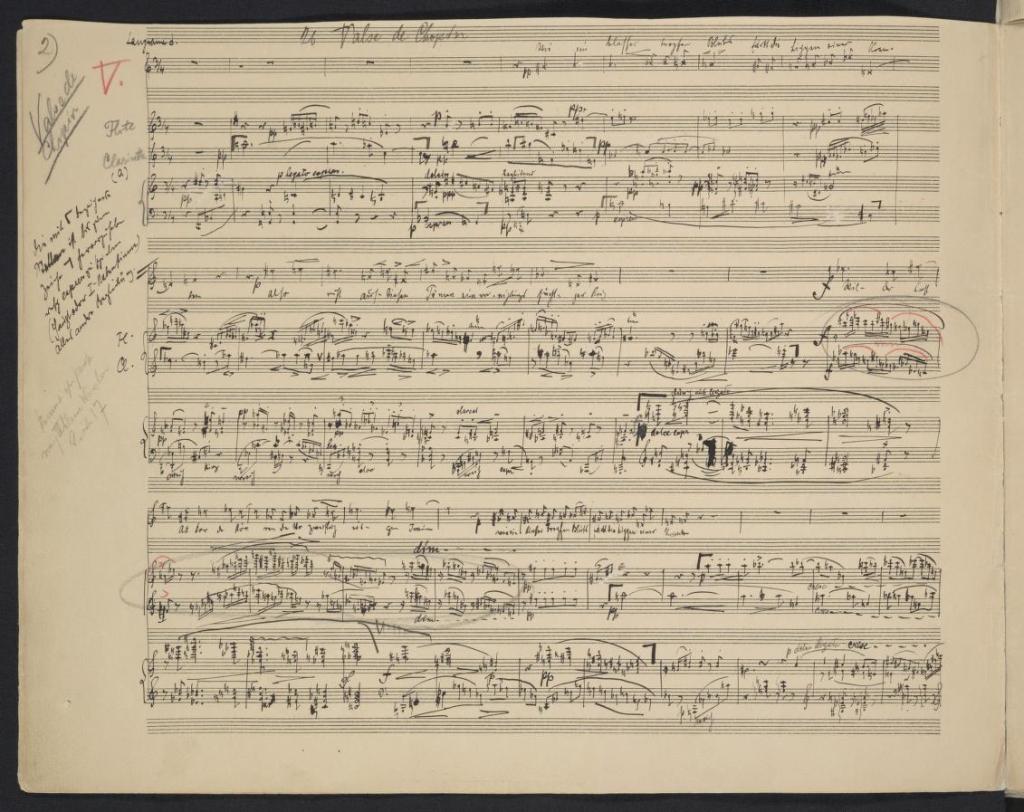
The medieval music theorist Guido d’Arezzo developed the four-line music staff—the precursor to the five-line staff—in or around the year 1024. Western art music notation as we know it today would not exist were it not for this revolutionary change. This February, the Daily Classical Music Post will explore music using interesting, unusual, and innovative music notation.
The Austrian composer Arnold Schoenberg (1874–1951) didn’t invent Sprechstimme; Engelbert Humperdinck used it in his first version of Königskinder in 1897, although he replaced it with conventional singing in the version that we know today. However, Schoenberg pretty much perfected it and used it in several works, most notably in Pierrot lunaire (1912).
The official name of Schoenberg’s Op. 21 is Dreimal sieben Gedichte aus Albert Girauds “Pierrot lunaire”, but people usually just call it Pierrot lunaire. This melodrama, which sets 21 poems from Albert Giraud’s cycle, was composed for reciter and a small instrumental ensemble. It is atonal (but not 12-tone), and is probably one of Schoenberg’s most famous works.
Schoenberg was very clear about how the performer was meant to interpret the notational language that he used to indicate Sprechstimme, and he also gave directions in a foreword to the score: “The melody given in notation in the vocal part (with a few specially indicated exceptions) is not intended to be sung. The performer has the task of transforming it into a speech melody [Sprechmelodie], taking the prescribed pitches carefully into account.”
In an analysis of recordings of Pierrot lunaire conducted by Schoenberg, Avior Byron said, “These recordings reveal that in a period of not more than three days, Schoenberg accepted relatively great freedom in the Sprechstimme pitch contour; as well as a contradictory tendency towards consistency and a certain systematic approach towards pitch, which does not always adhere to the score. . . . [T]he Sprechstimme enigma is greatly clarified when one understands that there are simultaneously two types of notation in Pierrot lunaire: one for the instruments that tends towards a reproduction of a sound object, and another for the Sprechstimme which involves a process of greater real-time interaction between performer and score.”
My classical music post for today is Arnold Schoenberg’s Pierrot lunaire.


Leave a Reply