

The medieval music theorist Guido d’Arezzo developed the four-line music staff—the precursor to the five-line staff—in or around the year 1024. Western art music notation as we know it today would not exist were it not for this revolutionary change. This February, the Daily Classical Music Post will explore music using interesting, unusual, and innovative music notation.
Jacob Senleches – Virelai “La harpe de melodie”
The Franco-Flemish composer Jacob Senleches (fl. 1382/1383–1395) was also a harpist, and he probably spent most of his life as a musician in the household of the Cardinal of Aragon. Documents show that when the Cardinal became Antipope Benedict XIII, he was elevated to a canonicate.
Although very little of Senleches’ output is extant, he is still considered to be one of the most important composers of the ars subtilior style. The compositions that we have are all polyphonic and in two or three parts. He was an innovator in rhythmic and notational styles.
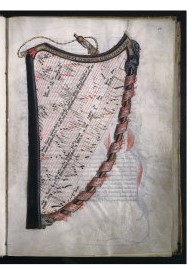
His virelai (a common medieval French form with three stanzas and chorus that comes before the first stanza and then after each one) La Harpe de Melodie is notable not just for its intricate canonic form but also for its unusual notation. The composition is written in the form of a harp, with the cantus and tenor voices notated on the strings and a rondeau that explains how to decipher the third voice written on a banner that is wrapped around the front pillar of the harp.
Interestingly, La Harpe de Melodie has been found in two medieval sources, a late-14th-century manuscript (this is the one in the form of a harp) and the Codex Chantilly. The latter manuscript is written on regular staves without an illustration, with the rondeau appearing below the staves. As we saw earlier this month in the piece by Baude Cordier, red coloration is used to indicate rhythmic variation.
Timothy Roy said, “Senleches’s La harpe de melodie epitomizes such self-reflexivity, its written transmission taking the form of a beautifully illuminated representation of a harp, its text extolling the sonorous splendor of the instrument. . . . [T]he piece would have been performed by a single person, likely Senleches himself, with the vocal line sung and the tenor and canonically-derived lines played on the harp.”
My classical music post for today is Jacob Senleches’ La Harpe de Melodie.


Leave a Reply