

Thank you to everyone who subscribes to and supports the DCMP. This January, I will be sharing some of the more popular posts from 2022 and 2023. A new theme will begin in February!
[First published 23 October 2023]
Oscar Wilde famously said, “Imitation is the sincerest form of flattery that mediocrity can pay to greatness.” It isn’t always the case, at least in classical music, that the imitator is mediocre; many compositions that are based on another composer’s work are just as interesting—and sometimes even more interesting—than the original. This October, the Daily Classical Music Post will look at variations, fantasias, and other compositions that are based on another composer’s work.
Grandes variations sur un thème du Comte Gallenberg, Op. 25 (Version for Piano & Orchestra)
The Austrian composer Wenzel Robert von Gallenberg married Countess Giulietta Guicciardi (to whom Ludwig van Beethoven had dedicated his Moonlight Sonata) in 1803. Comte Gallenberg, as he was known, was particularly famous for his ballets. One of his main appointments was as Directeur des ballets in the court theatre of Naples.
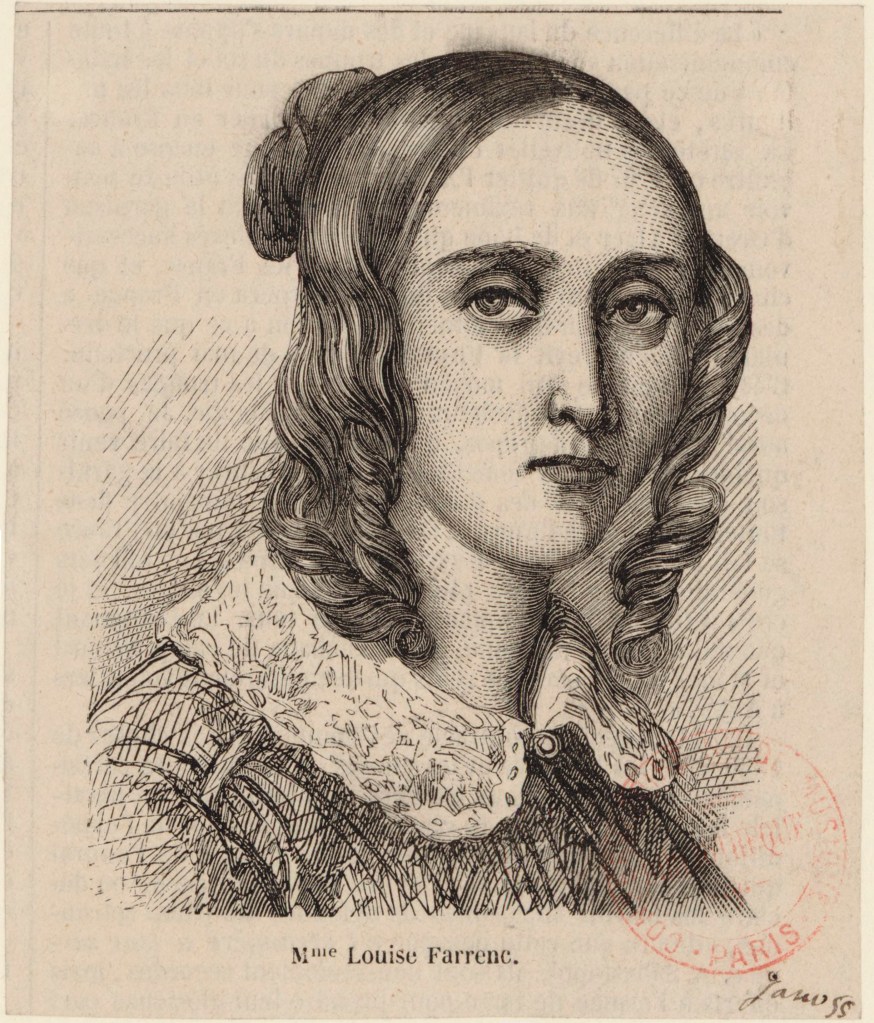
The French composer Louise Farrenc (1804–1875) was renowned throughout France and Europe as a pianist and composer in her lifetime, but until recently her music has been forgotten and ignored. Paul Corfield Godfrey said that Farrenc’s music displays “a measure of originality and invention that makes it easy to understand how the music of Farrenc won the approval of such a critic as [Hector] Berlioz.”
The Grand Variations on a Theme by Count Gallenberg has been described as a “showcase for virtuosic elegance.” Ivan Moody said, “The Grand Variations on a Theme by Count Gallenberg . . . are dramatic, but their real objective is to provide a showcase for the solo pianist’s virtuosity. . . . As is so often the case with sets of variations, there is nothing particularly remarkable about Gallenberg’s original theme, but it is what Farrenc does with it that is interesting. . . . She used the form as a vehicle for all the elegance and technical display of which she was capable—as one would expect of a work with the word ‘Grand’ in its title—but also once again discovered a rich seam of lyricism; in fact, this lyricism only increases as the variations reach their conclusion.”
My classical music post for today is Louise Farrenc’s Grand Variations on a Theme by Count Gallenberg.


Leave a Reply