

Dmitri Shostakovich: Symphony No. 13, I: “Babi Yar”
In September 2023, North Carolina classical radio station WCPE created an uproar when the music director announced that they would ban broadcasts of several operas being performed by the Metropolitan Opera. It didn’t take many weeks for that decision to be reversed. Sometimes, however, it takes years or even generations for composers and music that has been banned to be heard. This November, the Daily Classical Music Post will look at some music that was banned for a wide variety of reasons.
Symphony No. 13 in B-Flat Minor, Op. 113 “Babi Yar”: I. Babi Yar. Adagio
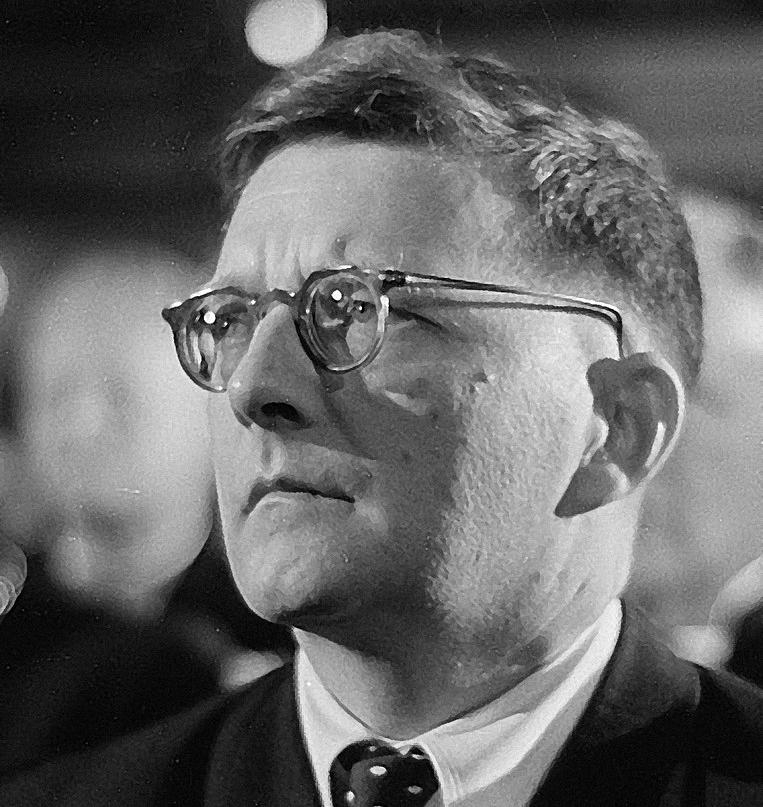
The Russian composer Dmitri Shostakovich (1906–1975) had a real up-and-down relationship with the Soviet government. He would be in favour for a while, then his music would be condemned and banned, and then he would be back in favour again. This happened when he composed his Symphony No. 13 in 1962.
Programme notes written for a performance at Carnegie Hall in New York City explain what the origins and meaning of Symphony No. 13:
Throughout his career, Shostakovich used Jewish themes in his music, but his boldest statement of solidarity with Jewish causes was the Symphony No. 13, “Babi Yar.” Some historic context: In 1941, Nazis and their sympathizers murdered nearly 34,000 Jews in two days at Babi Yar, a ravine near Kiev. For years, Soviet authorities suppressed any acknowledgement of the atrocity, did not erect a monument, and even went so far as to arrest Jews who prayed at the site.
Dissident poet Yevgeny Yevtushenko’s 1961 poem “Babi Yar” reflects on the massacre and is a searing condemnation of anti-Semitism and the Soviet system that condoned it. Shostakovich was mesmerized by the poem and planned to set it as a cantata, but eventually added other Yevtushenko poems to create a five-movement symphony for bass-baritone, male chorus, and large orchestra with an expanded percussion section.
From the start, the choice of Yevtushenko’s poetry put the Soviet censors on edge. Several musicians declined to participate in the premiere. The choir nearly walked out. Cameras that were meant to televise the performance were removed in a very ostentatious manner. The premiere did go ahead, and it was a resounding success, but soon after the government banned any more performances, and the work was not heard again in Russia for many years.
The first movement is basically a funeral elegy to Jewish suffering. Harlow Robinson said, “[W]hat most surprised Yevtushenko’s readers was the poem’s accusation that Russians, and even citizens of the theoretically socialist, anti-racist, and egalitarian USSR, were themselves guilty to some degree of the virulent anti-Semitism practiced by the Nazis. . . . Massive and imposing, heavy with foreboding and grief, the opening measures [of Symphony No. 13] sound like a cold wind rattling through a graveyard, immediately plunging us into a world of terrible suffering and injustice. The frequent use of tolling bells (heard in the first and last measures) creates a nearly religious, requiem-like atmosphere.”
My classical music post for today is Dmitri Shostakovich’s Symphony No. 13, I: “Babi Yar.”


Leave a Reply