

George Antheil: Ballet Mécanique
September is a month of unusual holidays, including “No Rhyme, No Reason Day,” “Wonderful Weirdos Day,” “Ceiling Fan Day,” and “Punctuation Day” (a personal favourite). To celebrate unusual holidays, this September the Daily Classical Music Post will explore music composed for unusual instruments either in ensembles or featured in a soloist capacity.
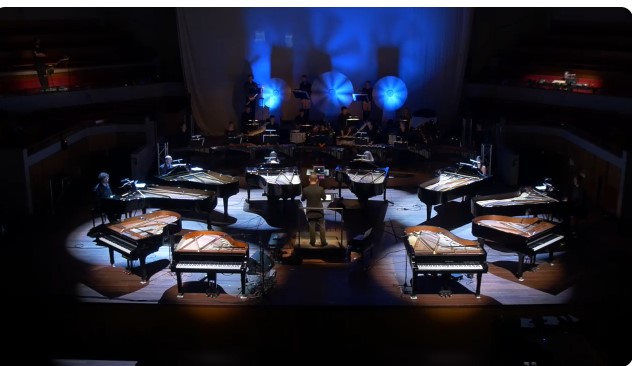
George Antheil Ballet Mecanique, INSOMNIO olv Ulrich Pöhl
Player pianos are so much fun! The first player piano, called the Pianola, was invented in 1896, and soon became really popular in homes, saloons, and even in concert halls. Piano rolls are still manufactured today, although they are no longer mass-produced in the way that they were in the early part of the 20th century. Pianolas allowed composers to write music that would be impossible for a human to play.
The American avant-garde composer George Antheil (1900–1959) was always pushing boundaries. He went to Paris to study and make a name for himself in 1922. He soon met experimental musicians, artists, and filmmakers who shared his ideas. In 1924, he was invited to compose music for the film Ballet Mécanique. Antheil said of this, his “first big work,” that it was “scored for countless numbers of player pianos. All percussive. Like machines. All efficiency. No LOVE. Written without sympathy. Written cold as an army operates. Revolutionary as nothing has been revolutionary.”
The score for Ballet Mécanique calls for 16 player pianos (or Pianolas) in four parts, 2 regular pianos, 3 xylophones, at least 7 electric bells, 3 propellers, siren, 4 bass drums, and 1 tam-tam. Early performances combined the music for the Pianolas into a few piano rolls to ensure that they were correctly synchronised.
A little side story: one of the main reasons why Antheil went to Paris was to meet his idol Igor Stravinsky. Although initially they were very close, Stravinsky heard that Antheil said “Stravinsky admires my work,” which displeased him enormously. Apparently, they did not talk for almost 20 years after that, which was devastating to Antheil. I thought of this when I learned that the first live performance of Ballet Mécanique resulted in a riot, just like Stravinsky’s Rite of Spring had.
More recently, Ballet Mécanique has been described as “a 1920s view of space-age music.” Robert Cummings said, “The music in Ballet méchanique is something few people are likely to forget, even from just one hearing. Play it for friends, or, better yet, for teenagers who think classical music is stuffy, straitlaced fare. They’ll take notice: driving rhythms and bell-like sonorities abound, as the music relentlessly moves forward in a mechanical manner, owing mainly to the hyperactivity of the pianos and xylophones.”
My classical music post for today is George Antheil’s Ballet Mécanique.


Leave a Reply