

Harold Shapero: Symphony for Classical Orchestra: Adagio—Allegro
First posted 29 April 2014
Who knew that three of the greatest conductors of the 20th century, Sir Thomas Beecham (1879–1961), Sir Malcolm Sargent (1895–1967), and Zubin Mehta (born 1936) share the same birthday, 29 April? If you were born on 29 April, then perhaps you also are destined to be a great conductor!
Harold Shapero (Symphony for Classical Orchestra)
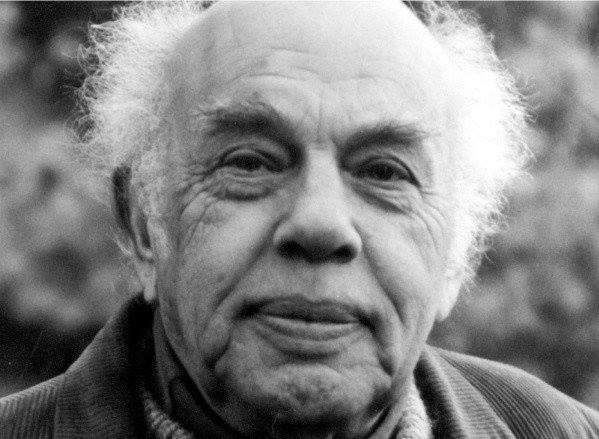
But today I am going to introduce you to an American composer, Harold Shapero, born on this day in 1920 (he died in 2013). Shapero studied with Nicolas Slominsky, Ernst Krenek, Walter Piston, and Paul Hindemith. He also studied with Nadia Boulanger, and received some advice and instruction from Aaron Copland and Igor Stravinsky.
In 1947, Shapero showed Stravinsky the score of the Symphony for Classical Orchestra, which led to its first performance by the Boston Symphony Orchestra conducted by Leonard Bernstein.
Copland thought highly of Shapero, but once noted in the New York Times that “[s]tylistically, Shapero seems to feel a compulsion to fashion his music after some great model. Thus, his . . . Serenade . . . is founded upon neoclassical Stravinskian principles, his three Amateur Piano Sonatas on Haydnesque principles, and his recent long Symphony [for Classical Orchestra] is modeled after Beethoven. . . . he seems to be suffering from a hero-worship complex—or perhaps it is a freakish attack of false modesty . . .”
Shapero wrote his Symphony for Classical Orchestra in 1947. Slominsky had this to say about this work: it is “premeditatedly cast in the proclamatory key of B-flat major, the natural tonality of the bugle, and ending in a display of tonic major triads.” But he also recognized modern features in the piece, with “the work’s orchestration, in general, . . . distinctively bright and brassy, and undoubtedly derived a fair amount from Piston and Copland, as well as from the composer’s experience as a dance band arranger.”
There have only been a couple of recordings made of this wonderful symphony, and as a result Shapero is not as well known as he should be. He has won several awards for his compositions, which include piano pieces, chamber ensemble works, and several pieces for trumpet.
My classical music post today is the first movement of Shapero’s Symphony for Classical Orchestra: Adagio—Allegro.


Leave a Reply