

Frank Bridge: Enter Spring
“That music always round me, unceasing, beginning, yet long untaught I did not hear, / But now the chorus I hear and am elated.”—Walt Whitman
Many composers get their inspiration from nature. There are so many beautiful places around the world. This June, the Daily Classical Music Post will travel around the world to national parks and reserves to discover the inspiration for some wonderful pieces of music!
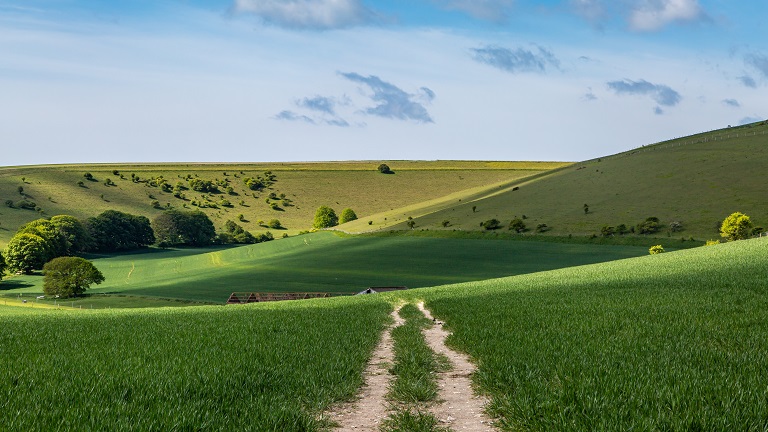
South Downs National Park covers parts of the counties of Hampshire, West Sussex, and East Sussex in England. It was created in 2010, although the idea for this national park was first floated in the 1920s. Some of the more notable landscape include the chalk hills of the South Downs, the white cliffs of Seven Sisters and Beachy Head, and the sandstone and clay hills of the western Weald. The South Downs Way runs through the park. Most of the park is chalk downland, created during the Late Cretaceous period.
Visitors to one of “Britain’s Breathing Spaces” can participate in dozens of organised and self-guided activities, including fly fishing, wildlife walks, foraging adventures, kayaking river trips, and walks and hikes along the coast. The entire park is covered by the Public Right of Way in England and Wales.
The English composer Frank Bridge (1879–1941) has been described as an “excitingly mysterious figure” and “an enigma.” It is true that he is nowhere near as well known as many of his contemporaries. His early style, according to Christopher Palmer, was “derived loosely from Delius, Debussy, and Ravel.” After World War I, he became much more pessimistic, partly because several of his most promising students, including Ernest Farrar, were killed in battle. He became interested in the music of Arnold Schoenberg and the Second Viennese School, and this is reflected in the style of his later works.
Bridge was born in Sussex and often returned there for holidays. Bridge and his wife built a cottage in Friston, on Sussex Downs, and this inspired him to compose a work that began life as “On Friston Down” but later became Enter Spring, considered to be one of his more avant-garde pieces. Robert Barnett says, “With Enter Spring’s echoes of Ravel and Stravinsky’s Rite of Spring, the music is complex but deeply tuneful. . . . Its combination of raw nature painting and his later sparer style is uniquely powerful.”
My classical music post for today is Frank Bridge’s Enter Spring.


Leave a Reply