

Roberto Gerhard: The Plague
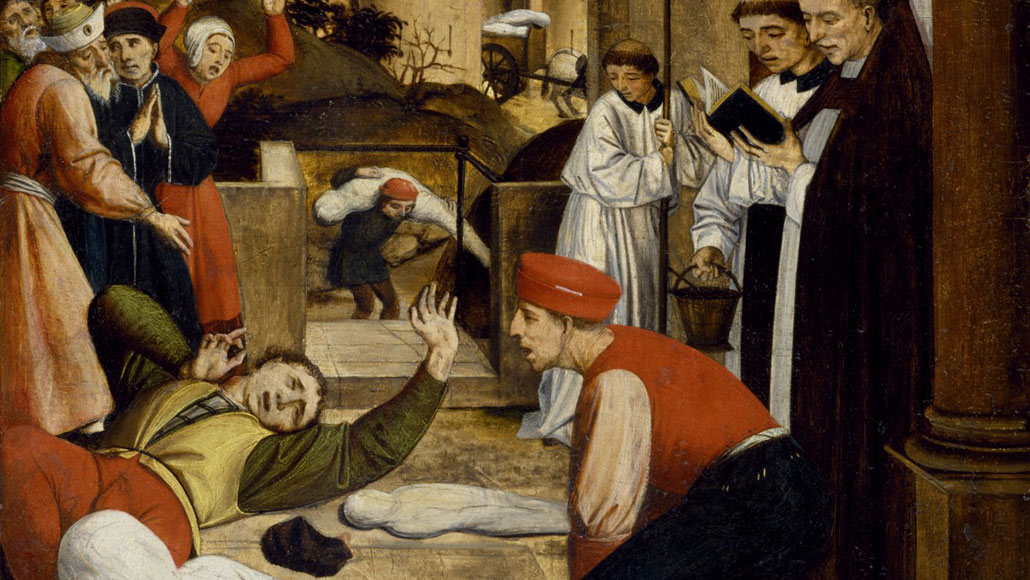
This April, the Daily Classical Music Post will look at composers who died during pandemics, as well as some who survived and a few who composed works to commemorate those who lost their lives.
“They fancied themselves free, and no one will ever be free so long as there are pestilences.”—Albert Camus
The Spanish Catalan composer Roberto Gerhard (1896–1970) composed his cantata The Plague based on the Camus novel La Peste.
Roberto Gerhard: The Plague (1963/1965)
Gerhard was Arnold Schoenberg’s only Spanish pupil. He was a true believer in the avant-garde and modernism. He said that “in music the sense is in the sound.” His music is an interesting development of serialism, incorporating elements of Spanish folk music as well as ideas utilized by composers including Béla Bartók and Igor Stravinsky. Gerhard had to leave Spain in 1939; he moved to England where he remained for the rest of his life. He is considered to be the first important composer of electronic music in the United Kingdom.
The Plague is an odd and unsettling work. Scored for chorus, narrator, and orchestra, it sets some sections of La Peste in English. The BBC Symphony Orchestra commissioned Gerhard to write this for a concert at the South Bank in 1963, so I guess that’s why it’s in English.
Anthony Payne reviewed the premiere, and had this to say: “Although as a rule pointillistic and extremely sparse, it maintains a continuity of musical experience by suspending animation.” Advanced instrumental and vocal techniques are used throughout to convey the horror and distress of the plague-stricken population. Not a happy work by any stretch of the imagination.
My classical music post for today is Roberto Gerhard’s The Plague.


Leave a Reply