

Johann Heinrich Schmelzer: collected works
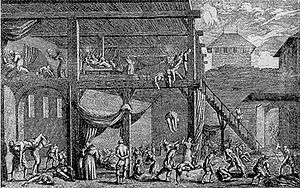
This April, the Daily Classical Music Post will look at composers who died during pandemics, as well as some who survived and a few who composed works to commemorate those who lost their lives.
“For it did not come in a part of the world nor upon certain men, nor did it confine itself to any season of the year, but it embraced the entire world.”—Procopius
The Austrian violinist and composer Johann Heinrich Schmelzer (ca. 1623–1680) died during a plague epidemic just after being appointed Kapellmeister to Emperor Leopold I. The Viennese court had moved to Prague to escape the Great Plague of Vienna of 1679, but unfortunately the plague followed them there.
J.H. Schmelzer: La Margarita – Music for the Court of Vienna&Prague [Armonico Tributo Austria]
The Great Plague of Vienna was in fact just one part of a global pandemic that possibly began in the Netherlands around 1650 or so, swept through London in the mid-1660s, and then ravaged most of Europe before moving on to the Ottoman Empire and North Africa.
Schmelzer enjoyed a reputation during his lifetime as the finest Austrian composer of the middle Baroque period. He also achieved great fame at a time when most of the more highly respected composers were Italian. There is evidence that he was a cornett player, but he was really known as a violinist and composer. He had various important court musician positions by the 1650s, including director of instrumental music for Leopold I’s coronation.
Schmelzer was particularly well known for his dance music; Laura Gayle Green says, “Schmelzer was a prolific composer of dance music, producing 150 dance suites, either for dramatic use or for court dancing, which for a time was one of his main responsibilities. . . . Other works include roughly 100 sonatas for various combinations of two to eight instruments.”
I have to admit that I did not really know much of Schmelzer’s music before writing this post, and perhaps some of you reading this also are unfamiliar with him. So, instead of sharing just one work of his, I have found a collection for you to enjoy. The first piece in the collection, “Balletto à cavallo,” is particularly fascinating: Mark Sealey says, “Although we can only begin to imagine the 1,700 individuals and 600 horses choreographed by Schmelzer’s balletto a cavallo, and may not find it more than a curiosity, we must be glad that—along with the several other state occasions to which the composer added his exceptional gifts—they were the cause for composition.”
My classical music post for today is a collection of works by Johann Heinrich Schmelzer.


Leave a Reply