

Throughout human history, technological developments have transformed the ways we live, work, communicate, and create. This November, the Daily Classical Music Post will explore compositions inspired by or made possible through many of these innovations and inventions, discovering how the changing world has shaped the music we make and hear.
Conlon Nancarrow, Study for Player Piano No. 21 (Canon X)
The American-born Mexican composer Conlon Nancarrow (1912–1997) had a rather unusual solution to a problem that has frustrated composers for centuries: what do you do when the music you’ve written is too difficult for anyone to play? Nancarrow simply dispensed with the performer! He devoted much of his career to composing for the player piano, a mechanical instrument that could reproduce extraordinarily complicated rhythms and passages at speeds far beyond the abilities of even the most accomplished pianist.
Nancarrow’s life was almost as extraordinary as his music. Born in Texarkana, Arkansas, he studied composition in Cincinnati and Boston and worked as a jazz trumpeter. In 1937, he travelled to Spain to fight against Franco’s forces in the Spanish Civil War, joining the Abraham Lincoln Brigade. After returning to the United States, he encountered hostility because of his left-wing political activities and moved to Mexico City in 1940, eventually becoming a Mexican citizen. He would spend most of the rest of his life there, working in relative isolation and developing his revolutionary musical ideas.
A player piano, or pianola, uses a roll of paper perforated with holes that determine which notes are played and when. As the roll passes through the instrument, a pneumatic mechanism operates the piano’s keys, producing sound without a human pianist. These instruments had been enormously popular in the early 20th century, particularly for reproducing familiar tunes in people’s homes. Nancarrow, however, recognised that the technology could do far more than imitate a conventional performance. Inspired partly by the American composer Henry Cowell’s theories about complex rhythms, he purchased two player pianos and a machine for punching holes into piano rolls. Working in his Mexico City studio, he painstakingly created rolls containing musical patterns that no human hands could possibly reproduce.
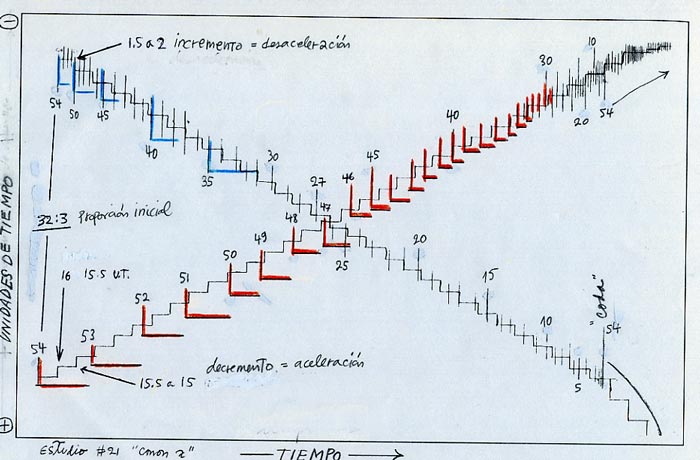
His Study No. 21, subtitled Canon X, dates from around 1961 and is one of his most remarkable experiments. A canon is a composition in which one musical line is imitated by another, as in a round. Nancarrow takes this familiar technique and transforms it into something extraordinary. Two musical lines begin at radically different speeds: the upper line moves extremely quickly and gradually slows down, while the lower line starts slowly and steadily accelerates. Eventually, the two reach the same speed before continuing past each other, so that the line that began slowly ends at a breathtaking pace. If their changing speeds were plotted on a graph, the lines would cross in the shape of an X, giving the piece its title.
The result is astonishing to hear. Notes tumble over one another in seemingly impossible combinations, yet the entire composition is governed by an extraordinarily precise mathematical structure. Nancarrow achieved this without computers, calculating the relationships between the different speeds and punching the required holes into the paper rolls himself. His work anticipated many of the possibilities that would later become available through computer-assisted composition, although his music remained little known outside a small circle of enthusiasts until the 1970s and 1980s. In 1982, he received a MacArthur Fellowship, bringing belated recognition to a composer who had spent decades quietly reinventing what a piano could do.
My classical music post for today is Conlon Nancarrow: Study No. 21, “Canon X.”


Leave a Reply