

Throughout human history, technological developments have transformed the ways we live, work, communicate, and create. This November, the Daily Classical Music Post will explore compositions inspired by or made possible through many of these innovations and inventions, discovering how the changing world has shaped the music we make and hear.
Halim El-Dabh – “Wire Recorder Piece” (1944)
The Egyptian composer Halim El-Dabh (1921–2017) was one of the earliest pioneers of electronic music, although his contribution to its history is not nearly as widely recognised as it deserves to be. Born in Cairo, he grew up in a musical family, learning piano and the darbuka, a traditional goblet-shaped drum. He studied agricultural engineering at Cairo University, but his fascination with music and the properties of sound led him towards an entirely different career. In 1944, while still a student, he created a composition that anticipated the development of musique concrète, the technique of making music by recording and manipulating sounds from the world around us.
El-Dabh had become interested in the zār, a traditional healing ceremony found in Egypt and other parts of northeastern Africa and the Middle East. The ceremonies often involve women singing, chanting, drumming, and dancing, with music playing an important role in rituals intended to address spiritual and emotional distress. El-Dabh was particularly fascinated by the relationship between sound and healing, and he wanted to investigate the unusual vocal qualities produced during the ceremonies. There was one problem: men were not permitted to attend the particular ceremony he wished to record. So, according to El-Dabh’s own recollection, he and his friend Kamal Iskander covered their heads and disguised themselves as women to gain admission!
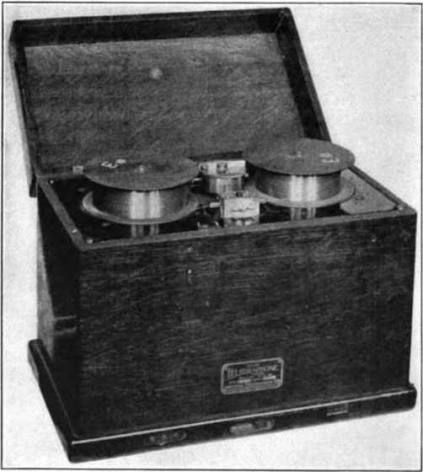
They brought along a wire recorder borrowed from the Middle East Radio Station in Cairo. Unlike a modern tape recorder, this machine stored sound magnetically on a very thin metal wire wound around a spool. Back at the radio station, El-Dabh began experimenting with the recorded voices, using electronic equipment to alter their frequencies, remove fundamental tones, and emphasise the higher harmonics. He also manipulated echo and reverberation, even changing the acoustic properties of the studio by moving its walls. The resulting sounds were transformed almost beyond recognition, becoming something entirely different from the original chanting.
He called the composition Ta’abir al-Zaar (The Expression of Zaar), and presented it at an art gallery in Cairo in 1944. A short surviving version is also known as Wire Recorder Piece. El-Dabh later recalled that he wasn’t consciously trying to invent electronic music; he was simply fascinated by the possibilities of exploring the hidden qualities of sound. He described his approach as being like a sculptor, taking pieces of sound and shaping them into something new.
Four years later, the French composer Pierre Schaeffer began his experiments with recorded sound in Paris, developing the techniques that became known as musique concrète. Schaeffer’s work received much greater international attention, and he is frequently credited with pioneering the genre. Yet El-Dabh had already demonstrated that recordings could become the raw material of a composition rather than simply a means of preserving a performance. He went on to study in the United States, worked with the choreographer Martha Graham, and taught African music and ethnomusicology at Kent State University in Ohio.
There is something particularly striking about the origins of The Expression of Zaar. A traditional healing ritual, recorded with relatively primitive equipment, became the starting point for an entirely new approach to composition. El-Dabh’s work reminds us that some of the most important technological innovations in music have emerged far beyond the European and American institutions usually associated with them.
My classical music post for today is Halim El-Dabh: Wire Recorder Piece.


Leave a Reply