

Throughout history, myths and legends have brought ancient mysteries and epic sagas to life. This September, the Daily Classical Music Post will explore how composers from different eras and continents have reimagined these stories through the universal language of music.
The legend of the Babylonian King Nebuchadnezzar II endures because he transformed ancient Babylon into an extraordinary and spectacular metropolis. He further secured his mythic status through his dramatic conquests. However, his sudden descent into madness has made him one of the most potent symbols of supreme human power and divine humility. His legacy bridges the gap between historical reality and myth.
In Chapter 2 of the Book of Daniel, Nebuchadnezzar has a very troubling dream, but he decides to use that dream as a test to see if his court magicians really have the power that they claim they have. He asks them to tell him what he dreamed about and what it means. None of them can tell him, but then the Hebrew prophet Daniel receives a vision from God and reveals both the dream and its meaning to the king.
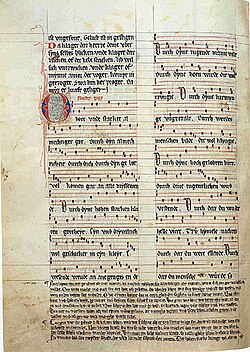
The Slavic minnesinger and Prince of Rügen Wizlaw III (1265–1325) wrote at least 17 songs that we know about. Minnesingers wrote poetry and music and performed in castles across medieval Germany. Wizlaw’s songs are generally in a popular rather than courtly style, and a few are unusually complex for minnesinger pieces.
One of his songs, “Dem kuninghe Nabughodonosor,” is a Sangspruch piece. Sangspruch (“sung-saying”) was a 12th- to 14th-century genre of medieval German lyric poetry. Instead of romance, the usual topic for minnesingers, Sangspruch focused on didactic, political, moral, and religious commentary. “Dem kuninghe Nabughodonosor” was preserved in the 14th-century Jenaer Liederhandschrift manuscript, with melodies and lyrics in Middle High German. The song recounts the biblical story of Nebuchadnezzar’s dream. Wizlaw, like many minnesingers, wrote multiple texts that share the same metrical structure. “Dem kuninghe Nabughodonosor” was one of the poems that he set to his Ton I. In the manuscript, the scribe took a shortcut and only wrote out the music once; all of the texts that were to be sung to it followed as text only.
Wizlaw III used the ancient legend of Nebuchadnezzar as a moral and political allegory for his contemporary world. He equated the diminishing value of the four different metals that Nebuchadnezzar saw in his dream to the moral decline of humanity, expressing that his current era represented the fragile, corrupted age of iron and clay.
This song is hypnotic in its structural repetition. Wizlaw creates a meditative atmosphere that makes the listeners think about what the dream was really about. The meaning of the words comes across clearly, as nothing interferes with the solo voice. “Dem kuninghe Nabughodonosor” is an absolutely mesmerizing piece of music.
My classical music post for today is Wizlaw III: “Dem kuninghe Nabughodonosor.”


Leave a Reply