

It’s May, and in the northern hemisphere, that means it’s spring! This May, the Daily Classical Music Post will explore music about May, spring, renewal, rebirth, and reawakening.
Das Jahr: 12 Characterstucke: No. 5. May
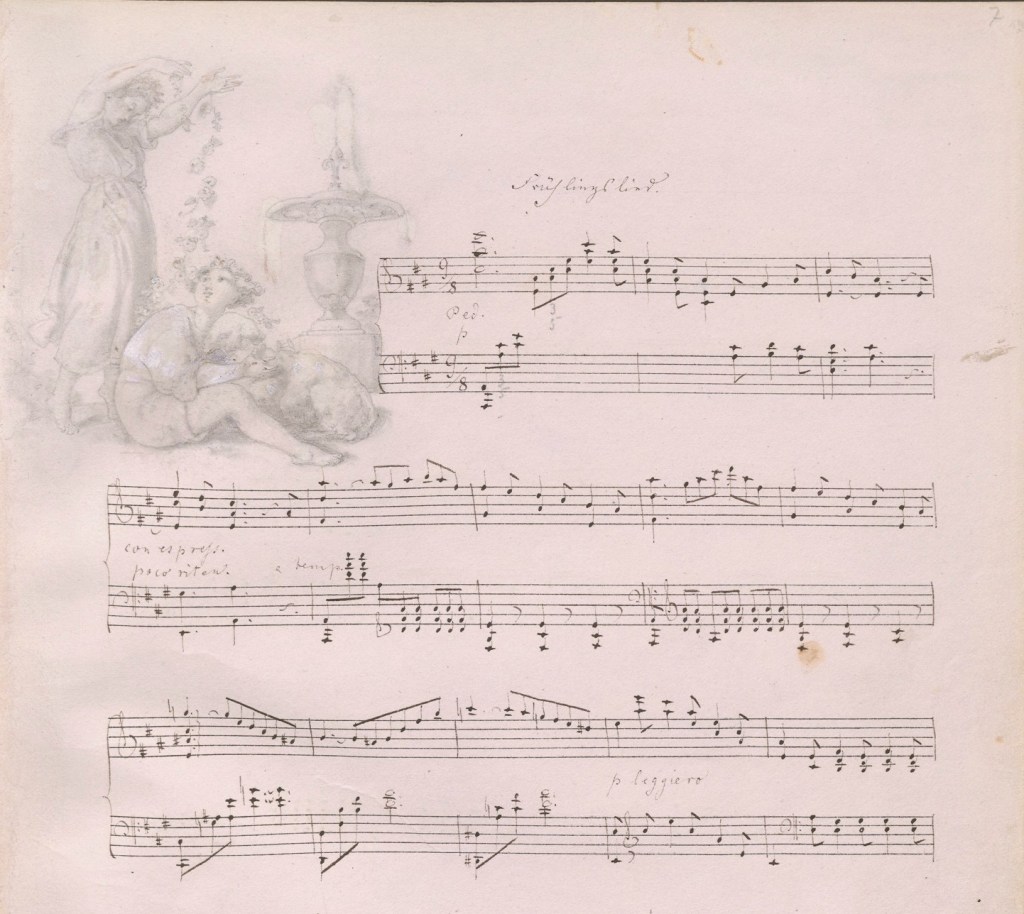
The German composer Fanny Mendelssohn Hensel (1805–1847) composed her piano work Das Jahr (The Year) in 1841. She wrote to a friend, “Now I’m engaged on another small work that’s giving me much fun, namely a series of 12 piano pieces meant to depict the months. . . . When I finish, I’ll make clean copies of the pieces, and they will be provided with vignettes. And so we try to ornament and prettify our lives—that is the advantage of artists, that they can strew such beautifications about, for those nearby to take an interest in.”
The website HenselPushers.com says, “Das Jahr (H385) is arguably Hensel’s greatest work. It was not published during her lifetime, though she did include one piece (September) as one of four pieces in her first opus of piano music, but without the title or subtitle (‘By the river’). The manuscript was rediscovered in 1989, almost 150 years after it was written.” The original manuscript included drawings for each month by her husband, the German painter Wilhelm Hensel, and there also was a short verse preceding each piece of music. The 13 pieces in Das Jahr (one for each month plus a postlude) show what a brilliant talent Hensel was, and what a loss it was to the world that she died so young.
No. 5, Mai, is subtitled “Frühlingslied” (Spring Song), and is preceded by the verse “Nun blüht, das fernste, tiefste Thal” (Now the farthest, deepest valley is in bloom), from the poem “Frühlingsglaube” (Faith in Spring) by the German poet Johann Ludwig Uhland. This beautiful, lyrical movement is, as Stuart Sillitoe wrote, “filled with the sights and sounds of springtime.” The lovely melodic phrases bring to mind butterflies flitting about in a field of spring flowers and animals emerging from their winter hideaways to enjoy the warmer weather.
My classical music post for today is Fanny Mendelssohn: Das Jahr: No. 5. Mai.


Leave a Reply