

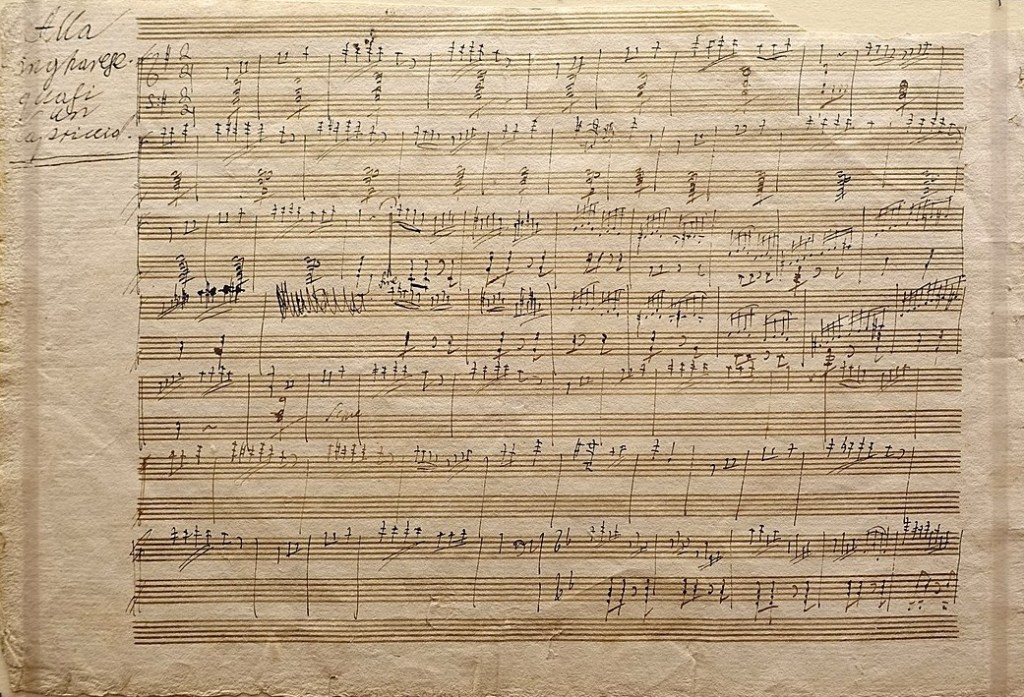
Composers leave works unfinished for many different reasons including untimely death, loss of inspiration, perfectionism, and, in some cases, a feeling that the work is already complete despite being technically incomplete. This February, the Daily Classical Music Post will explore unfinished works and find out the ways in which they are performed today, either still incomplete or finished by other composers.
Olga Scheps – Beethoven – Rage Over a Lost Penny, Op. 129 (Official Video)
The German composer Ludwig van Beethoven (1770–1827) left behind a significant number of sketches, fragments, and unfinished compositions, including maybe as many as 50 incomplete symphonies. Beethoven often struggled with or lost interest in continuing projects, partly because he was quite self-critical. Some of the fragments and sketches ended up in completed works, but most of the musical ideas were abandoned.
Some time between 1795 and 1798, Beethoven began work on a rondo for piano. The official title is Rondo alla ingharese quasi un capriccio in G Major, Op. 129, but the piece is better known by the title Rage Over a Lost Penny, Vented in a Caprice. Beethoven almost certainly did not give it this name; it’s more likely that his friend Anton Schindler wrote it on the manuscript, and the handwriting isn’t Beethoven’s anyway. There’s no explanation as to where that title came from. As far as the original title goes, there is no such word as “ingharese”; it has been speculated that Beethoven meant to write “all’ungharese” to emphasize the Hungarian style of the rondo.
Robert Schumann was a great fan of this piece and wrote, “It would be difficult to find anything merrier than this whim. . . . It is the most amiable, harmless anger, similar to that felt when one cannot pull a shoe from off the foot. . . . I had to laugh from the beginning to the end when I played it for the first time recently.”
This audience-pleasing composition was published by Anton Diabelli in 1828. Diabelli “completed” the work, making some changes, filling in missing notes, and adding sections. He also hid the fact that the work was incomplete. No one knew that Beethoven had not finished it until 1946, when the original manuscript was discovered. The discrepancies between Beethoven’s unfinished version and Diabelli’s were easy to spot. A more recent edition by Jochen Reutter notes, “Beethoven’s autograph of the work, written around 1795, has been preserved, although it is not quite complete. The new edition is based on it as the main source; the first edition, published posthumously by Diabelli, provided a reasonably plausible orientation for the ‘missing parts’ in the original manuscript. In the few problematic passages, more convincing solutions were sought on the basis of the autograph material.”
My classical music post for today is Ludwig van Beethoven: Rage Over a Lost Penny, Vented in a Caprice.


Leave a Reply