

Composers leave works unfinished for many different reasons including untimely death, loss of inspiration, perfectionism, and, in some cases, a feeling that the work is already complete despite being technically incomplete. This February, the Daily Classical Music Post will explore unfinished works and find out the ways in which they are performed today, either still incomplete or finished by other composers.
MONNA VANNA (Rachmaninoff): Sherrill Milnes, John Alexander, & Tatiana Troyanos
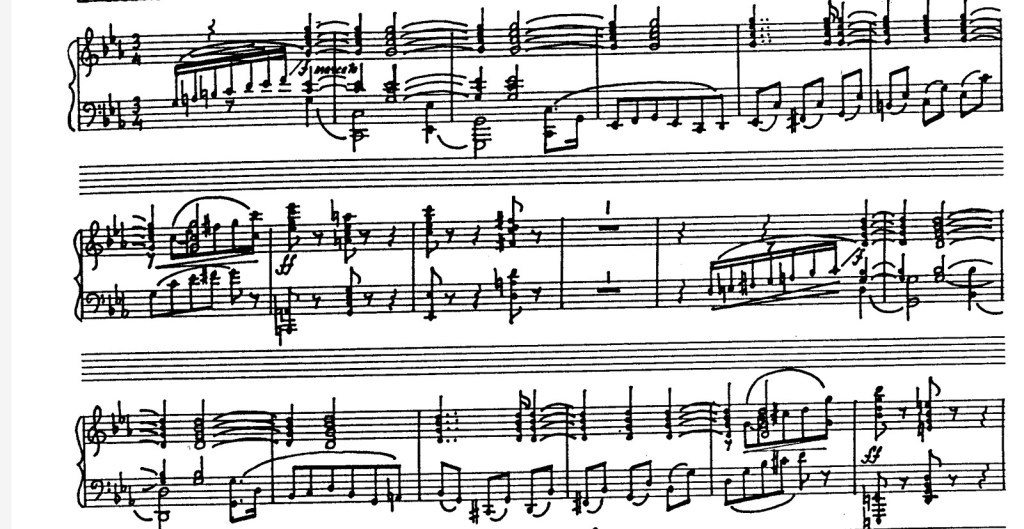
In the early 1900s, the Russian composer Sergei Rachmaninoff (1873–1943) had already begun working on a piano and vocal score based on Monna Vanna, by Maurice Maeterlinck, when he realized that he needed to ask the playwright if it could be okay for him to write a three-act opera setting the text of the play. Unfortunately, Maeterlinck had already given the rights to the French composer Henry Février. European copyright law at the time would not allow for two works based on the same play to be performed, so although Rachmaninoff had completed Act I of Monna Vanna, he stopped work on the opera and never went back to it. He was reportedly crushed that he couldn’t set the rest of the opera, and he often would play excerpts from Act I on the piano for friends. He made some revisions to the score in 1941. An orchestrated version of Act I by the Russian conductor Igor Buketoff was staged at Saratoga Springs, New York, in 1984. Sadly, it was performed in English; it would be so much better in Russian.
Geoffrey Norris wrote, “The surviving manuscript of Act 1 has been orchestrated by Igor Buketoff in a faithful imitation of 1907 Rachmaninov—the Rachmaninov of the Second Symphony, to which the opera bears certain fleeting motivic resemblances. In his treatment of the text Rachmaninov follows but softens the free, deftly inflected arioso manner of his earlier The Miserly Knight and Francesca da Rimini, allowing the music to burgeon sumptuously (and also to give a foretaste of the second movement of The Bells) on the first appearance of Monna Vanna herself. Even though it remains a tantalising torso, this single act does demonstrate that Rachmaninov had the musical vocabulary to interpret Maeterlinck’s fraught, romantic plot with telling dramatic touches.”
A review in Gramophone of today’s recording noted, “The story is of the defence of Pisa in the fifteenth century and the rage of Guido, commander of the garrison, when his wife Giovanna agrees to offer herself to the Florentine leader. The completed act is in the kind of accompanied recitative style that Russians from Dargomizhsky (The Stone Guest) to Shostakovich (The Gamblers) have adopted from time to time. . . . A workshop performance such as this gives at least a useful general impression of the work. For that, and for Buketoff’s dedicated work of restoration, we should be grateful. His sleeve-note understandably stresses his personal contact with Rachmaninov and the latter’s special attachment to the opera—as he says, it was the only major work the composer put in his suitcase when he left Russia at the end of 1917.”
My classical music post for today is Sergei Rachmaninoff: Monna Vanna.


Leave a Reply