

Composers leave works unfinished for many different reasons including untimely death, loss of inspiration, perfectionism, and, in some cases, a feeling that the work is already complete despite being technically incomplete. This February, the Daily Classical Music Post will explore unfinished works and find out the ways in which they are performed today, either still incomplete or finished by other composers.
Bruckner: Symphony No. 9 – Karajan / 브루크너: 교향곡 9번 – 카라얀
The “Curse of the Ninth” is a classical music superstition that says a composer’s ninth symphony will be their last, leading to death before a tenth. This myth became popular after Ludwig van Beethoven’s death, as he died not long after finishing his Ninth. Many composers were haunted by the myth, and some of them died while still working on their own ninth symphony.
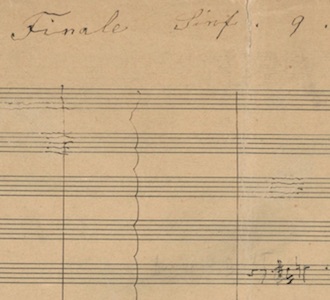
The Austrian composer Anton Bruckner (1824–1896) was famously critical of his own music, constantly tinkering with apparently completed works and also discarding compositions that he felt did not say what he wanted them to say. He began working on his Symphony No. 9 in d minor (WAB 109) in 1887, not long after completing the first version of his Symphony No. 8. He then put No. 9 to one side, instead concentrating on revising No. 8 as well as other pieces. It took six years for Bruckner to finish the first movement of No. 9. He worked on the second movement from 1889 to early 1894. He finished the third movement in late 1894. A note on his calendar indicates that he began sketching out the fourth movement in May 1895. However, this movement was never completed.
William Carragan wrote, “The Ninth Symphony has only one version, consisting of three movements with extensive sketches of the finale. If Bruckner had lived to complete the finale, he would almost certainly have gone over the other movements and made adjustments. Thus what we have is a work in progress.”
Some musicologists and composers have attempted to make some sort of sense of Bruckner’s fragments and sketches for the fourth movement. There also are stories that Bruckner might have envisioned his Te Deum as the possible end of the symphony in place of the sketched-out fourth movement, even though it would have been odd to have a d minor symphony end with a C Major Te Deum. In any event, he was working on an instrumental fugue for the fourth movement when he died, so it’s impossible to know exactly what he intended.
Symphony No. 9 is considered to be one of the greatest symphonies in the repertoire, even though it is incomplete. Some performances and recordings include a reconstruction of the fourth movement, but the three completed movements stand on their own: two beautiful slow movements surrounding the surreal, almost menacing second movement.
My classical music post for today is Anton Bruckner: Symphony No. 9.


Leave a Reply