

Composers leave works unfinished for many different reasons including untimely death, loss of inspiration, perfectionism, and, in some cases, a feeling that the work is already complete despite being technically incomplete. This February, the Daily Classical Music Post will explore unfinished works and find out the ways in which they are performed today, either still incomplete or finished by other composers.
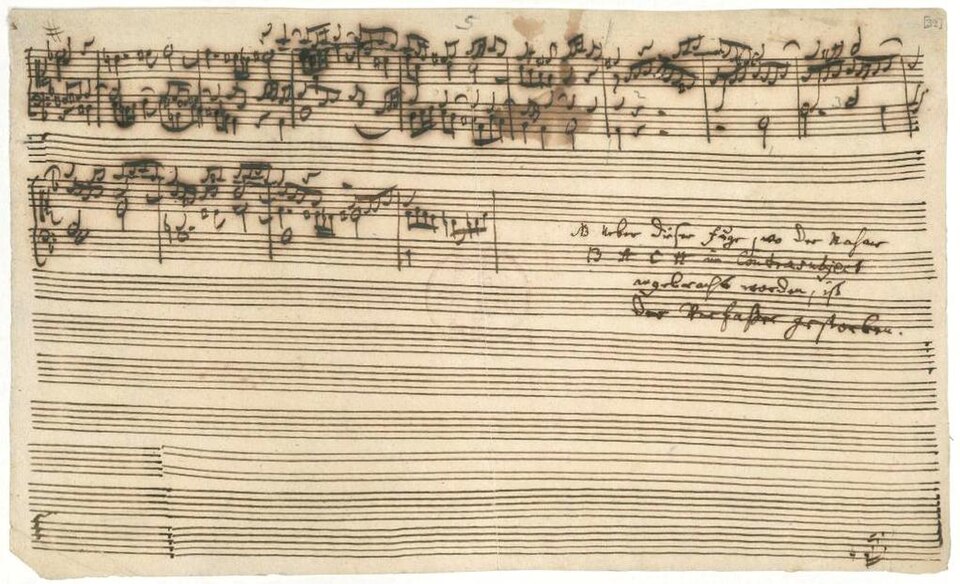
The Art of the Fugue, BWV 1080: Contrapunctus XIV (Fuga a 3 Soggetti) unfinished
The German Baroque composer Johann Sebastian Bach (1685–1750) spent the last decade of his life working on his monumental instrumental work The Art of the Fugue, BWV 1080. This incomplete monothematic piece consists of fourteen fugues and four canons in D minor. Each uses a variation of a single subject, and it is a marvellous example of what this master of counterpoint achieved in his compositions.
Bach did not specify on what instrument he intended The Art of the Fugue to be played; he wrote it in open score, that is, each voice is on its own staff. Some musicologists believe this is because The Art of the Fugue was meant to be an intellectual exercise, not a work to be performed. Other musicologists and musicians are convinced that it was composed for keyboard, as it was common in the 17th and 18th centuries to write contrapuntally complex works in open score.
Contrapunctus 14, known also as Fuga a 3 Soggetti, was included with the manuscript for the rest of The Art of the Fugue. It is sometimes called the “Unfinished Fugue” as it stops abruptly in the middle of the third section. Bach’s son Carl Philipp Emanuel wrote a note on the manuscript page: “While working on this fugue, which introduces the name BACH, the composer died.” However, some scholars believe that the note is in Bach’s own handwriting, so it’s all pretty curious, to say the least. Most of the manuscript was composed in 1742, although the engraving was not undertaken until 1749.
Although some composers have made attempts to complete Contrapunctus 14, many performers play it as Bach left it, stopping in mid phrase. Peter Gutmann wrote, “Performers face a difficult decision of how to treat the final fragment. It has been suggested that Bach stopped on purpose, so as to invite his successors to grasp the initiative to complete it. Accepting the invitation, attempts range from adding a simple cadence (Riemann) to several minutes of development following insertion of the primary Art of the Fugue theme as a fourth subject (Tovey). Most, though, let the music trail off, just as Bach left his manuscript.”
My classical music post for today is Johann Sebastian Bach: The Art of the Fugue: Contrapunctus 14, Fuga a 3 Soggetti.


Leave a Reply