

Happy New Year! I’ll be taking a break from writing new posts this month, but never fear, there will still be a Daily Classical Music Post! This January, I’ll be sharing some DCMPs from Januarys in the past. And stay tuned for a whole new theme in February!
First posted January 2011
Composers dedicate pieces of music to others for many reasons. Sometimes it is a way to thank or honour a mentor or patron. Sometimes it is to express friendship or love interest. Maybe the composer wants to remember someone close to them who has died. And maybe it’s just to celebrate a favourite place or event. This January, the Daily Classical Music Post is introducing you to a selection of works with dedications.
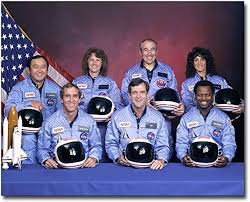
Anyone who was alive in 1986 is likely to remember where they were when the Space Shuttle Challenger broke up less than two minutes after liftoff, killing all seven members of the crew. The American composer Christopher Rouse (born 1949) was working on his symphonic poem Phaethon, and he dedicated this work to all of the crew members.
Rouse is known mostly for his orchestral compositions, and Phaethon is one of his most popular, although initial reviews were less than stellar (Donal Henahan said that the work “testified chiefly to the composer’s ability to put an orchestra in motion and keep it there without the support of a memorable musical idea”). His works are mainly atonal in the neoromantic genre, although he did combine tonal and non-tonal worlds in his concertos primarily.
Phaethon was commissioned by the Philadelphia Orchestra. In the programme notes, Rouse said, “The legend tells of Phaethon, son of the sun god, Helios. The boy, after doubts had been aroused concerning his parentage, secured from his mighty father a promise that he would be allowed to demonstrate irrevocably his divine origins. Helios swore to permit such a demonstration, but he was horrified when Phaethon demanded to be allowed to guide the chariot of the sun across the sky for one day; as Helios had made his oath in the name of the river Styx, Olympian law required that he guarantee his promise. Once off, Phaethon realized quickly that he lacked the ability to control his father’s horses, which dashed madly across the sky. They hurtled too close to the earth, set its land aflame, and dried up its rivers. They raced through the universe and finally threatened even Olympus itself, forcing Zeus to destroy Phaethon by hurling at him a thunderbolt which knocked him from the chariot to his death. . . . In a disturbingly ironic twist, I found myself on the morning of January 28, 1986 at bar 443 of the work, the measure in which Zeus’ thunderbolt knocks Phaethon from the sky, when the space shuttle Challenger exploded shortly after takeoff. Phaethon is dedicated to the memory of Judith Resnik, Gregory Jarvis, Ronald McNair, Ellison Onizuka, Michael Smith, Francis Scobee, and Christa McAuliffe—the seven astronauts who lost their lives that morning when they, too, were knocked from the sky.”
My classical music post for today is Christopher Rouse: Phaethon.


Leave a Reply