

Happy New Year! I’ll be taking a break from writing new posts this month, but never fear, there will still be a Daily Classical Music Post! This January, I’ll be sharing some DCMPs from Januarys in the past. And stay tuned for a whole new theme in February!
First posted January 2013
“riverrun, past Eve and Adam’s, from swerve of shore to bend of bay, brings us by a commodius vicus of recirculation back to Howth Castle and Environs.”
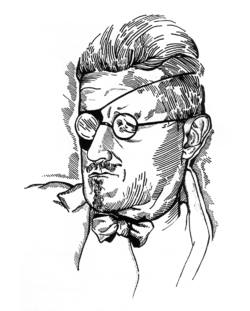
Today is the anniversary of the death of the Irish novelist and poet James Joyce (2 February 1882–13 January 1941). The lines above are from Finnegans Wake, his comic work considered to be one of the most difficult works of fiction ever published in the English language. Joyce employed stream of consciousness, literary allusions, free dream association, and many other techniques in Finnegans Wake. I have read it, but I am led to believe that I am in a minority. Just don’t ask me to explain it to you.
The American composer Stephen Albert (1941–1992) composed his first symphony, Symphony RiverRun, in 1983. The composer said about this work: “The Symphony RiverRun is one of two works begun at roughly the same time [early 1983]. The other work, TreeStone, is a song cycle based on selected passages from James Joyce’s Finnegans Wake, the text of which forms a wildly distorted version of the Tristan and Isolde story, and is scored for soprano, tenor, and twelve instrumentalists. Both works were completed together, and they share the same musical materials. (I actually worked on the two compositions in constant alternation, though the materials common to both were put into TreeStone first.) They differ in the number and ordering of their movements, as well as their formal architecture and instrumentation. . . . The symphony and its four movements carry descriptive titles, not because the work is specifically programmatic, but in order to suggest its broad kinship to the song cycle (in which Ireland’s Liffey River plays such a dominant role), and also to acknowledge the importance that Joyce’s atmosphere in the TreeStone text had on my frame of mind. I did not do my composing to a specific programmatic outline; the titles of the symphony’s four movements were affixed only after each of the respective movements was completed. The title I gave to the work as a whole, RiverRun, is in fact the very first word of the first sentence of Finnegans Wake.”
According to the liner notes (by Richard Freed) for one recording of this work, “The opening movement, ‘Rain Music,’ conveys the origins of a river. After the sharply accented chords of the movement’s introduction, the music becomes quieter, suggesting an atmosphere of expectancy. The momentum of the movement gathers speed and power, finally ending with a return to the movement’s opening chords, now climactically pitted against a repetition by the brass, bells, piano and harps of melodic fragments heard earlier in the movement.”
This symphony is a marvelous piece; had Albert not died tragically in a car crash at the age of 51, he would have continued to compose interesting and exciting music, I am sure.
My classical music post for today is Stephen Albert: Symphony RiverRun, I. “Rain Music.”


Leave a Reply