

Happy New Year! I’ll be taking a break from writing new posts this month, but never fear, there will still be a Daily Classical Music Post! This January, I’ll be sharing some DCMPs from Januarys in the past. And stay tuned for a whole new theme in February!
First posted January 2016
January 2016 is Celebrate 19th-Century American Composers on the Daily Classical Music Post!
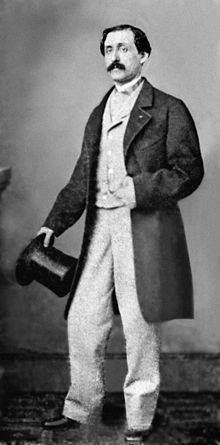
Louis Moreau Gottschalk – La Nuit des Tropiques / A Night in the Tropics
As Douglas Shadle says in his recent book Orchestrating the Nation, most present-day concertgoers may never hear any of the 100+ symphonies composed by American composers in the 19th century. To most classical music fans, the 19th century is all about the Russians, the Germans, perhaps some other Europeans, but American music of that time is considered to be popular (e.g., Foster). The first American composer most people will have heard is Ives.
This January, the Daily Classical Music Post aims to correct this. As the music of so many 19th-century American composers is either lost or not performed, it has not been all that easy to find large-scale works. During this month, you will perhaps discover some music that will pique your interest, and perhaps more ensembles will look into performing something other than the usual European standards!
Louis Moreau Gottschalk (1829–1869) was best known in his lifetime as the “Chopin of the Creoles,” but, as S. Frederick Starr says, he probably should also have been known as “the Crescent City’s Schubert.” Gottschalk was a virtuosic pianist and travelled throughout the United States and South America performing his own works. He worked on his large-scale works while travelling. He had plans to complete these larger works and publish them, but he died suddenly at the age of 39, and several manuscripts disappeared in the confusion that followed. It is possible that several trunkloads of manuscripts could be unearthed somewhere in Brazil; wouldn’t that be a find!
Richard Rosenberg says of Gottschalk’s Symphonie romantique, “La nuit des tropiques,” “Gottschalk’s A Night in the Tropics (1859) had only been performed since his death in condensed and ‘corrected’ versions. My reconstruction of this work is based on the composer’s autograph manuscript, with instrumental forces not quite as large as those employed at Gottschalk’s own performances (which featured over 650 musicians) but quite large nonetheless. It retains Gottschalk’s unusual voice leading and notation. . . . I incorporated the sound of ‘harmonieflautas’ at the end of the first movement (based on Gottschalk’s own account of where and how it was employed), using an antique South American concertina. In the final movement of A Night in the Tropics, Gottschalk indicated only the first measure of the Afro-Cuban percussion, using the notation ‘Bamboula’. He fully expected the ensemble to improvise the remainder of that samba movement in a manner that places it as a sort of ‘missing link’ between nineteenth-century concert music and a musical language that would soon evolve into that of Jazz.”
La nuit des tropiques is not really a symphony; it is more like two tone poems linked together. James Reel says, “The first movement is a broad, lyrical Andante free of any American touches. It takes its general inspiration from the Symphonie fantastique of Berlioz, Gottschalk’s mentor, as well as the works of Wagner. Strings dominate the first several minutes of the movement, building a very gradual crescendo and then drawing the woodwinds and brass into a supporting role in a more agitated section. After a sustained, dramatic episode, the movement winds down into the opening string material. The thematic model, and to some degree a structural one as well, is clearly Wagner’s Tannhäuser overture. Gottschalk cuts loose in the second movement Allegro moderato. Deploying the full percussion section and now making more prominent use of the winds and brass, the movement sways and bumps to the Cuban rumba rhythm, which was unknown in the U.S. during Gottschalk’s lifetime; this may be that dance’s first orchestral setting. Gottschalk insinuates a little fugue near the climax to provide his symphony some academic solidity, but the splashy music never skips a Latin beat.”
My classical music post for today is Louis Moreau Gottschalk: Symphonie romantique, “La nuit des tropiques.”


Leave a Reply