

December is a month for reflection, a time to look back on the past year before looking ahead to the new one. In 2025, there was so much great music to share that I wasn’t able to fit all of it in! So this December, the Daily Classical Music Post will revisit the theme for each month and share a few of the works that didn’t make the cut.
“Troubled Island” Opera Music – William Grant Still
[February 2025: February is Black History Month in the United States of America and Canada, and LGBT History Month in the United Kingdom and Ireland. This February, the Daily Classical Music Post will celebrate both by sharing some favourite posts from the past several years on Black and LGBTQIA+ composers.]
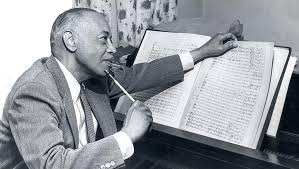
William Grant Still (1895–1978) was the first Black American to conduct a major American symphony orchestra (the New Orleans Philharmonic Orchestra), the first to have a symphony (his first symphony) performed by a leading orchestra (the Rochester Philharmonic Orchestra), the first to have an opera performed by a major opera company (the New York City Opera), and the first to have an opera performed on national television (on PBS).
Still collaborated with the poet Langston Hughes (the libretto was completed by Still’s wife Verna Arvey) on the three-act grand opera Troubled Island, based on a play by Hughes about the revolution that led to the foundation of the Black republic of Haiti. Still worked on the score from 1936 to 1939. The opera was produced in 1949 by the New York City Opera company under the direction of Laszlo Halasz. It was rapturously received by the audience—more than 20 curtain calls—but as Still’s daughter Judith later recounted, “Howard Taubmann came to my father and said ‘Billy, because I’m your friend I think that I should tell you this—the critics have had a meeting to decide what to do about your opera. . . . [They think you have gone] far enough and they have voted to pan your opera.’ And that was it. In those days, critics had that kind of influence.”
The music in Troubled Island is mostly tonal, incorporating blues and Haitian traditional melodies—and very accessible. Catherine Parsons Smith says that Still “found himself isolated from both black and white critics by his commitment to the use of a blues-based aesthetic in his concert music and operas. . . . He nevertheless used a musical language that was, in relation to modernist concert music, straightforward.”
Apparently, the Metropolitan Opera Co. had planned to stage Troubled Island before the NYCO but mysteriously dropped the idea. Ben Levine, writing in 1949, pointed out the irony of censoring a work in the United States while at that time criticizing censorship in the Soviet Union. And, interestingly, the New York City Opera came about precisely to present Troubled Island. As Celeste Headlee says, “The NYCO sprang from an effort by [Former First Lady Eleanor] Roosevelt and New York Mayor Fiorello LaGuardia to raise the funds needed to produce the opera ‘Troubled Island’ by African-American composer William Grant Still. They had heard the Metropolitan Opera had rejected Still’s scores and decided to help produce the work independently.”
My classical music post for today is William Grant Still: Troubled Island.


Leave a Reply