

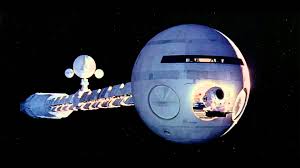
Music is a journey, taking listeners on an emotional and sometimes adventurous sonic path through time to new places both physical and spiritual. Some composers have chosen actual methods of transportation as their theme for this excursion. This October, the Daily Classical Music Post will feature music celebrating methods of transportation, from the land to the sea to the air.
Karl Birger Blomdahl: Aniara (1959) Atto I
People have dreamt of space travel for centuries. The earliest known story of space travel is by Lucian of Samosata; this second-century work, A True History, describes a voyage to the moon. Other early stories about travelling to the moon and planets include Johannes Kepler, Somnium (1634); Cyrano de Bergerac Comical History of the States and Empires of the Moon (1656); and Jules Verne, From the Earth to the Moon (1865). Space travel became a reality in 1957 with the launch of Sputnik 1, and there was no looking back.
The Swedish composer Karl-Birger Blomdahl (1916–1968) was one of the most influential experimental composers of the 20th century. Jenny Rood and Juliette Victor wrote, “His first instrumental compositions, dating from the late 1930s, recall Nielsen and Sibelius, while those from the 1940s show influences of Hindemith’s ‘new objectivity’ deriving from Blomdahl’s active participation in the ‘Måndagsgrupp’ (The Monday Group), a gathering of young people involved in writing and playing music and studying its history.”
In 1959, Blomdahl caught the Space Age bug and composed Aniara, a two-act opera to a libretto by Erik Lindegren. Blomdahl described the opera as “a revue about Man in Time and Space.” Lindegren based his libretto on the 1956 epic poem by Harry Martinson, which tells the tragic story of a massive spaceship, the Aniara, which is transporting thousands of human colonists to Mars after Earth has become uninhabitable. Everything goes horribly wrong during a celebration when the spaceship is thrown off course. The computer on board the Aniara, called the Mima, is operated by Mimaroben, who delivers a message of mankind’s evils to the hapless passengers.
A review of the premiere said, “The music of Blomdahl, related in style to Bartók’s and Stravinsky’s, was summed up by the liberal paper, Dagens Nyheter, as among the outstanding of modern compositions. ‘Aniara,’ the paper added, ‘has an originality that once would have put him [Blomdahl] in the first rank of international composers—if he had not already been there.’ The composer also was hailed for his use of taped electronic and ‘concrete’ music for special symphonic effects. ‘Aniara,’ a two-act work that took two hours to perform, was received enthusiastically by a capacity house. Twenty-five curtain calls were taken.”
My classical music post for today is Karl-Birger Blomdahl: Aniara, Act I.


Leave a Reply